



How Will the TSMC Expansion Affect Home Values in Peoria and North Glendale?
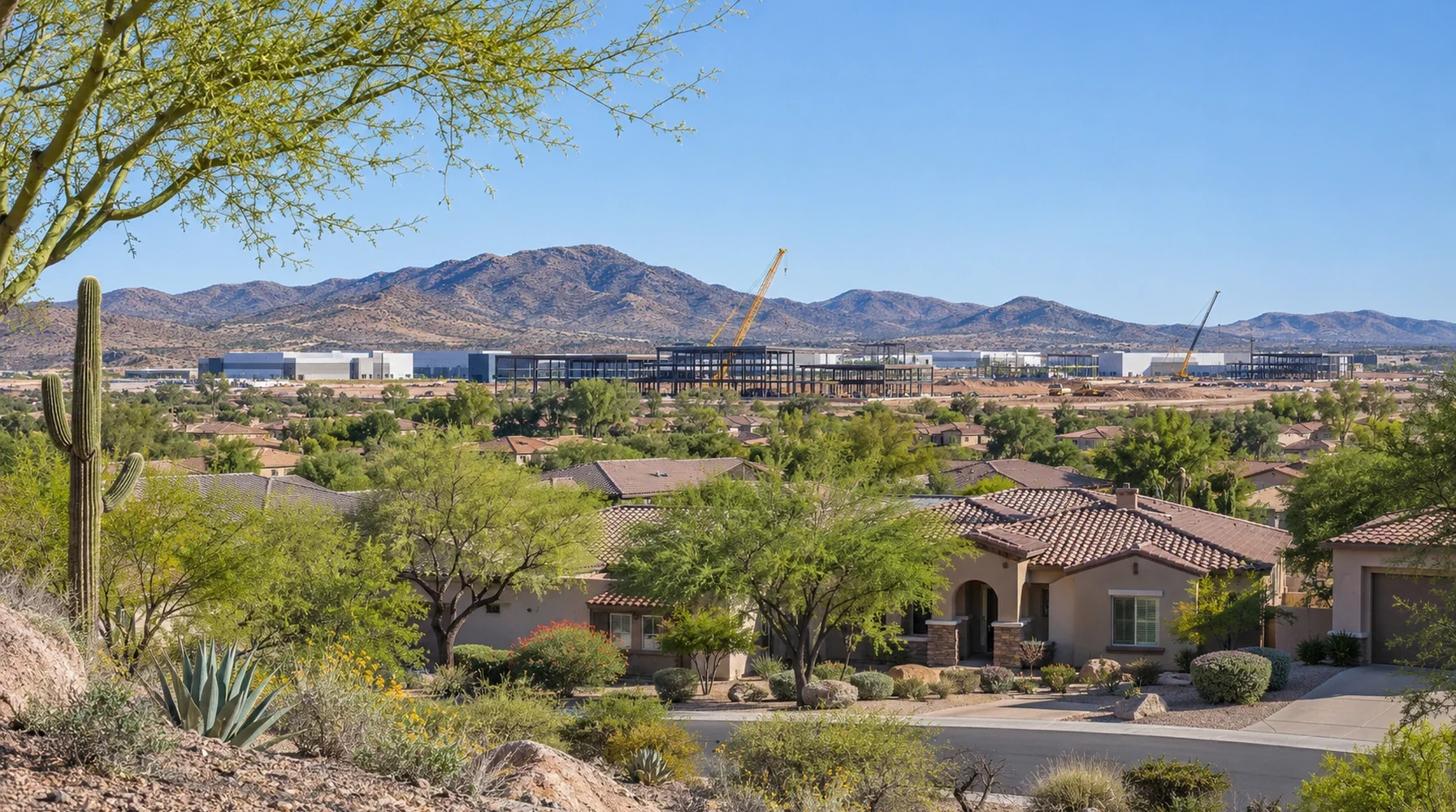
How will the TSMC expansion affect home values in Peoria and North Glendale?
The TSMC expansion is creating long-term upward pressure on home values in Peoria and North Glendale, driven by thousands of incoming tech jobs, a wave of new residents, and major supporting development already underway. This is not a short-term spike. It is a multi-decade economic shift anchored in the world’s largest foreign direct investment in U.S. history, and the effects are already visible in builder activity, land prices, and buyer demand across the West Valley.
What the TSMC Expansion Actually Means for the West Valley
The TSMC expansion means a long-term employment base for the West Valley, and before getting into what this means for your home or your next purchase, it helps to understand the scale of what’s happening.
TSMC (Taiwan Semiconductor Manufacturing Company, the world’s largest chipmaker) has committed $165 billion to a semiconductor campus in North Phoenix, near the Loop 303 and Interstate 17 corridor. That investment includes six chip fabrication plants (fabs), two advanced packaging facilities, and a research and development center. The first fab is already in production. A third fab broke ground in April 2025. Volume production on the second fab, running 3-nanometer chips, is expected to start in the second half of 2027. For you, the size of that commitment is the point: an employer planning at this scale is planning to hire for decades, not a single season.
What makes this particularly relevant for Peoria specifically: Amkor Technology, a global semiconductor packaging company, broke ground on a $7 billion campus in Peoria in October 2025. That facility, expected to be the largest of its kind in the United States, will package and test chips produced at TSMC’s nearby fabs for Apple, Nvidia, and other customers. Amkor’s Peoria campus is projected to create up to 3,000 skilled jobs in engineering, operations, and advanced manufacturing, with the first phase completing construction in mid-2027.
These are not speculative announcements. The land has been purchased, the groundbreakings have happened, and the infrastructure is being built. The economic engine running through Peoria and North Phoenix is already moving, and it is moving through your neighborhood.
Why Home Values in Peoria Are Under Upward Pressure
Home values in Peoria are under upward pressure because the city is tied directly to the semiconductor build-out. Peoria is not adjacent to the TSMC campus, but it is directly involved in the supply chain. The Amkor facility in Peoria’s Innovation Core represents a different kind of demand driver than a distant employer. Workers at that campus will want to minimize commute time, which means housing demand will concentrate in Peoria and the immediately surrounding communities.
The City of Peoria itself has made a $140 million infrastructure investment to support the Amkor site and the broader Peoria Innovation Core. That public commitment is a signal: city leadership expects this growth to be sustained and is structuring infrastructure around it. When cities invest at this scale, it tends to accelerate private housing development in the same corridor.
Established communities in North Peoria, including Westwing Mountain, Rock Springs, Aloravita, and Sonoran Mountain Ranch, are already in the price range that incoming tech workers can reach. Most listings near this corridor have been coming in between $500,000 and $700,000, with some older homes still available in the $400,000 to $500,000 range. That inventory window is unlikely to stay open at those levels as more workers arrive and fewer homes are available relative to demand.
If you’re evaluating which West Valley community fits your lifestyle and commute priorities, this guide to the differences between Peoria and Phoenix breaks down schools, neighborhood character, and the growing employment centers near Loop 303 that are reshaping how families think about where to put down roots. For a closer look at the Innovation Core itself, see how the Peoria Innovation Core could affect home values.
What North Glendale Looks Like in This Picture
North Glendale occupies a strategic position in the TSMC story. It sits closer to the TSMC North Phoenix campus than central Peoria does, and its housing stock, a mix of established neighborhoods and newer planned communities, has been attracting homebuilder attention for the same reason.
The pattern already visible in North Glendale mirrors what has played out near other major tech campuses: buyers willing to pay a premium for shorter commutes, inventory shrinking faster than new supply can fill it, and rental demand rising alongside for-sale demand. TSMC’s North Phoenix campus is driving workforce relocation into the Glendale and Peoria corridors, and the AZ Big Media 2026 Phoenix housing market outlook notes that the campus continues to expand hiring in engineering, operations and materials science, and quotes the Greater Phoenix Economic Council on these employers bringing the kinds of salaries that support homeownership. If you own in North Glendale, our look at TSMC Phase 2 and property taxes in North Glendale covers the cost side of the same story.
This is usually where I slow buyers down to make sure they’re thinking clearly about timeline. The value growth in these areas is real, but it is also uneven. Properties in the direct commute corridor to either the TSMC campus or the Amkor Peoria site are positioned differently than homes further west or south. Zip code matters here in a way it hasn’t for some time. Before making a decision based on the general narrative of “TSMC is good for the market,” it’s worth mapping exactly where you’re buying relative to where the jobs are concentrated.
– Gloria B, Buckeye, AZ
The New Development Layer, and Why It Matters to You
The new development layer near the TSMC corridor matters because it shapes future supply in Peoria and North Glendale. It is tempting to read the wave of new master-planned communities near the campus as pure competition with existing homes. The reality is more nuanced.
Halo Vista, a 2,300-acre mixed-use development anchored around the TSMC campus, plans nearly 9,000 residential units. Whether those homes will be rented, sold or both has not been confirmed. If they end up mostly rentals, they would not compete directly with for-sale homes in Peoria or North Glendale and would instead house workers who are not yet buyers, potentially moving some future demand into the for-sale market over time as those workers establish roots.
NorthPark, the separate roughly 19,000-unit master-planned development being developed with PulteGroup, does include for-sale homes. That project will add significant supply to the corridor over the next decade-plus. The important word there is “decade-plus.” Development at that scale unfolds in phases, and the near-term supply picture in established Peoria and North Glendale neighborhoods is not materially affected by a 20-year buildout timeline. NAR research on how job relocations affect local real estate markets confirms that large employer arrivals consistently elevate housing demand in surrounding communities; the question is always timing and proximity, not whether the effect is real. If you’re weighing whether to wait for these projects, our post on buying now near TSMC or waiting for Halo Vista and NorthPark walks through that choice.
For sellers in these markets: the new development confirms the long-term demand story. For buyers, it means that the window to purchase in established communities, before significant price appreciation compounds further, is the active question right now.
What Sellers in Peoria and North Glendale Should Understand
Sellers in Peoria and North Glendale should understand that the TSMC and Amkor backdrop helps, but it does not price your home for you. If you own a home in Peoria or North Glendale and are thinking about selling, this economic backdrop is one of the most favorable structural environments this market has seen. That said, it is worth separating the macro story from your specific property’s position within it.
Not every home in these cities is equally positioned to benefit. Location relative to the Amkor and TSMC employment corridors matters. Price point matters: the incoming workforce skews toward engineering and technical roles with salaries in the $80,000 to $130,000+ range, which tends to concentrate buyer demand in the $400,000 to $650,000 range. The condition and presentation of your home still determines whether a buyer chooses yours over the one down the street.
At this stage, I help clients narrow their focus to what they can actually control: pricing strategy, preparation, and timing. The macro demand story doesn’t close a deal; the net sheet (the estimate of what you walk away with after costs), the condition, and the marketing plan do. If you’re in a neighborhood that sits in the commute corridor to either campus, your positioning conversation is different than if you’re further from the employment centers. Those are not the same listing strategy, and they shouldn’t be approached the same way. Our post on pricing a Peoria home before Amkor hiring starts goes deeper on that.
Under the Arizona Association of REALTORS (AAR) purchase contract, sellers are required to complete a Seller’s Property Disclosure Statement, the SPDS, which is the form where you tell buyers what you know about your home’s condition and history. This protects all parties and is a standard part of the process. In a market with high buyer demand, well-prepared disclosures and a clean transaction process matter as much as ever.
What the Infrastructure Timeline Means for Buyers
For buyers in Peoria and North Glendale, the infrastructure timeline separates demand that has already arrived from demand that is still coming, and that is one of the most useful frameworks for buyers right now.
The first wave (TSMC workers, construction crews, supplier executives) has been in this market for several years. That group drove the initial activity increase in the North Valley corridor. The second wave is what’s building now: Amkor’s Peoria campus broke ground in October 2025 and is expected to begin production in early 2028, hiring engineering and operations talent as it ramps. That is a known, dated event with a direct housing demand implication for Peoria. TSMC’s land acquisition of 900 acres near Loop 303 and I-17, purchased for nearly $200 million in early 2026, confirms the expansion is accelerating, not moderating.
Buyers who purchase in Peoria and North Glendale now are positioning ahead of that second wave. Buyers who wait for “more certainty” are often waiting for the moment when prices have already incorporated the demand they were watching arrive. There is no single correct answer to the timing question; it depends on your financing, your timeline, and what you’re buying. But the structural case for these markets is as data-supported as any in the Phoenix metro right now.
In Arizona, your purchase is governed by the AAR contract, which provides a 10-day inspection period. Your earnest money, the good-faith deposit that shows the seller you’re serious, is typically 0.5 to 1% of the purchase price in this market. Closing through a title company takes approximately 30 days. These are the mechanics of getting from offer to keys, and they apply equally whether you’re buying in a rising market or a flat one.
More Helpful Real Estate Videos from Kasandra
Stay confident in your real estate journey with Kasandra’s latest Arizona tips and insights. This video covers Peoria neighborhoods for commuting to Phoenix.
You can find more in the full video playlist.
Frequently Asked Questions About TSMC and Home Values in Peoria and North Glendale
Will TSMC actually make home prices go up in Peoria and North Glendale, or is this just hype?
The investment is real and in progress. Amkor’s $7 billion Peoria campus broke ground in October 2025 and will create up to 3,000 jobs, with production beginning in early 2028. Housing demand here is rising from a real employment base, not speculation.
How soon will I see price changes in Peoria neighborhoods near the Amkor facility?
Price pressure is already present in the North Peoria corridor, and Westwing Mountain and Aloravita have seen increased buyer interest. The bigger inflection point is likely as Amkor moves into production, projected for 2027 to 2028.
Does it make sense to buy near Halo Vista?
Halo Vista plans roughly 9,000 residential units, and whether they will be rented, sold or both has not been confirmed. Either way, nearby for-sale communities benefit from the employment density, so watch how its first phases are offered.
Should sellers in Peoria wait to list until more workers arrive?
The market is moving now, not later. Seller timing depends on your personal circumstances, your home’s condition, and pricing, not on waiting for a future demand peak that may already be priced in once it’s clearly visible.
What parts of North Glendale are most affected by the TSMC expansion?
Areas along and near the Loop 303 corridor and within reasonable commute distance of Deer Valley, where the TSMC fabs are located, have the strongest proximity argument. Your specific neighborhood is worth a detailed conversation.
How much is TSMC investing in Arizona?
TSMC has committed $165 billion to its North Phoenix campus, covering six chip fabrication plants, two advanced packaging facilities and a research and development center.
Will NorthPark add for-sale homes near Peoria and North Glendale?
Yes. NorthPark, being developed with PulteGroup, plans roughly 19,000 units including for-sale homes. It will unfold in phases over many years, so it does not change this year’s supply in established neighborhoods.
The Decision Ahead of You Is About Information, Not Headlines
The TSMC story has generated a lot of noise: projections, estimates, and competing narratives about what it means for homeowners and buyers across the Valley. Most of what circulates is true at a macro level. What it doesn’t tell you is what it means for your street, your price point, and your specific window of time.
What matters for your decision is understanding how the Amkor and TSMC employment corridors overlap with where you’re buying or selling, what the real supply picture looks like in your target neighborhoods, and how the mechanics of an Arizona purchase, from inspection period to title company to closing timeline, protect your interests along the way. The West Valley is in the middle of a generational shift. The families and professionals arriving here are choosing Peoria and Glendale not because they’re settling; they’re choosing them because the jobs are here, the communities are established, and the lifestyle infrastructure is already in place.
That combination is rare, and it is worth understanding clearly before you make your next move. My job is to give you clear, personalized guidance based on today’s market and your unique situation, so you can make that move with clarity and confidence.
If you want to talk through how the TSMC and Amkor expansion affects your specific home or your next purchase in Peoria or North Glendale, let’s explore your options. You can reach me, Kasandra Chavez with the Chavez Dream Home Team, at 928-910-7401, or grab a time on my calendar.