


How Loop 303 Growth Affects Surprise AZ Traffic Noise and Resale
How will continued Loop 303 corridor growth in Surprise affect traffic, noise, and home resale value if I buy near the freeway?
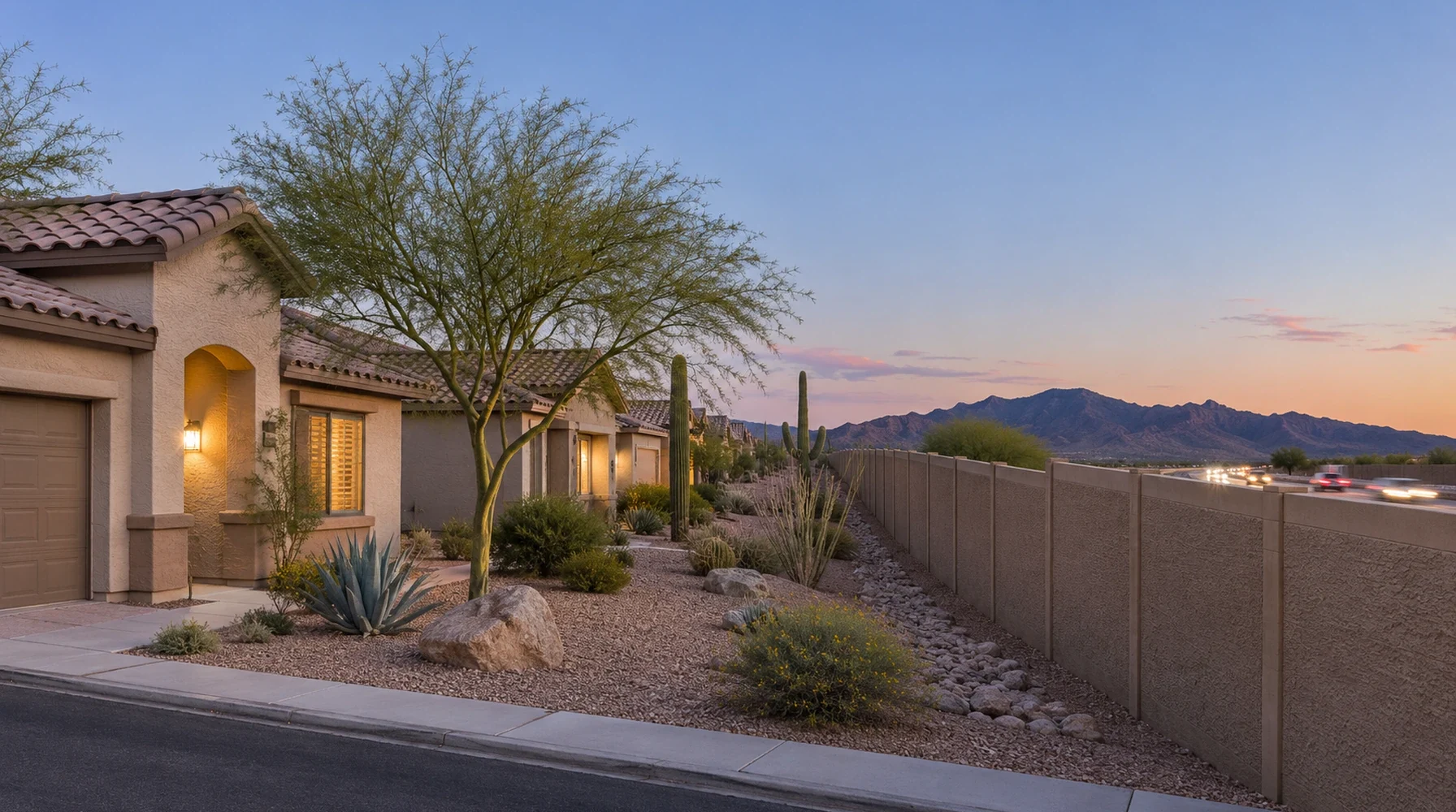
Loop 303 corridor growth has been a net positive for Surprise home values overall, but the impact varies sharply by distance from the freeway. Homes positioned three to ten streets in from the 303 capture the access and amenity benefit without absorbing the traffic and noise penalty. Homes that directly back the freeway, sit on the noise-wall side of a subdivision, or face a major feeder arterial typically appreciate more slowly and take longer to sell, regardless of how strong the broader corridor story is.
Buyers ask me about this almost every week. The answer isn’t “Loop 303 = good” or “Loop 303 = bad.” It’s that the corridor is creating real, durable demand for Surprise, and within that demand, the specific lot, lot orientation, and noise-wall positioning of the home you’re considering matter more than the macro story. Here’s what I watch for when I walk a property near the 303 with a buyer who’s worried about resale.
What’s actually driving Loop 303 traffic right now, and where it’s going
Loop 303 traffic near Surprise is being shaped by two forces at once: widening work that will add freeway capacity, and new employment along the corridor that is adding commuters. Both matter if you are buying a Surprise home close to the freeway.
The 303 is widening. According to ADOT, work on the $129 million Loop 303 Improvement Project between I-17 and 51st Avenue got underway the weekend of February 21 and 22, 2026, building direct freeway-to-freeway ramps at I-17 and widening the 303 to three lanes in each direction. A separate widening from 51st Avenue west to Lake Pleasant Parkway is scheduled to start in fall 2026, according to ADOT’s Loop 303 project page. Both projects are funded through Proposition 479, the voter-approved regional transportation plan for Maricopa County. The headline: more capacity is coming, which will ease congestion at peak times, but the construction itself will be a multi-year disruption that buyers should factor in.
Notice where that work sits. Loop 303 runs north from I-10 through Goodyear and Surprise into Peoria, then turns east at Lake Pleasant Parkway toward I-17. The current widening is on that eastern stretch, from Lake Pleasant Parkway in Peoria to I-17 in north Phoenix. For most Surprise homes near the 303, it shows up as slower commutes toward I-17 rather than crews working behind the back wall.
The traffic isn’t accidental either. Major employment nodes along and adjacent to the corridor (TSMC in north Phoenix, Amkor’s expanding semiconductor packaging campus in north Peoria, the broader Loop 303 industrial buildup) are generating commute patterns that didn’t exist five years ago. That’s good news for long-term demand on Surprise homes within easy 303 access. It’s less good news for homes that sit directly against the freeway during the years when peak traffic is still flowing through the un-widened sections. If you already own near the corridor, our post on whether the 303 expansion will increase your home value in Surprise looks at the same growth from the seller’s side.
What the noise penalty actually looks like on resale
For a Surprise home that backs Loop 303, the noise penalty shows up in three measurable ways. First, longer days on market, meaning the home sits listed longer before a buyer goes under contract: buyers who tour the home in person notice the noise and either pass or expect a discount. Second, these homes more often close below their original list price than non-adjacent homes in the same subdivision. Third, a narrower buyer pool: many buyers screen out freeway-adjacent homes during the search phase before they ever tour, so showings drop.
That’s not unique to Surprise. It’s how freeway-adjacent housing performs in every metro. What makes Surprise specific right now is the construction overlay. A home that backs the 303 during the widening years can carry both the standing noise penalty and a construction disruption penalty, and how much of the second one applies depends on how close the home sits to active work. Some buyers will tolerate both for the right price. Most won’t tolerate either at full asking. At this stage, I help buyers narrow their focus to two questions: how much price reduction is appropriate for the freeway adjacency, and how long do you plan to live there before you’d sell?
– Dan and Lori G, Sun City, AZ
How to read a specific lot for actual noise exposure
How much Loop 303 noise a Surprise home actually absorbs comes down to the specific lot, not the corridor. The macro story is helpful. The specific lot is decisive. When I tour a Surprise property near the 303 with a buyer, I’m looking at five things, and you can do most of this yourself before you even submit an offer:
- The noise wall: Concrete walls along the freeway absorb meaningful sound but don’t eliminate it, and older walls or walls with gaps perform worse.
- The building setback: The setback, meaning the distance between the house and the freeway, matters because every fifty feet of it compounds.
- The lot orientation: Homes with bedrooms or backyards facing the freeway carry a bigger lifestyle penalty than homes with garages or driveways on the freeway side.
- Elevation and topography: Homes sitting at or below freeway grade catch less sound than homes elevated above it.
- The time you visit: Touring at 11 a.m. on a Saturday tells you nothing about Tuesday at 5 p.m. commute hour.
Walk the backyard, listen, and visit twice at different times. This is the single most underrated step in evaluating a freeway-adjacent home, and most buyers skip it because the home itself is appealing on paper. For a different kind of West Valley noise question, our post on whether Luke AFB noise is a deal-breaker for resale in western Glendale covers aircraft noise.
When the trade-off actually works in your favor
A home that backs Loop 303 in Surprise can work in your favor when you plan a long hold, negotiate the right discount, and the noise genuinely does not bother you. There’s a category of buyer for whom freeway-adjacent homes are a smart play. Investors holding for cash flow rather than near-term resale, buyers who want a specific neighborhood at a discount and plan to stay 10+ years, and buyers who legitimately don’t experience freeway noise as a stressor can each capture real value by buying what others reject. The corridor is appreciating, the 303 widening will eventually ease peak congestion, and the discount you negotiate today against comparable non-adjacent homes is the spread you keep on resale if you stay long enough for the construction phase to end and the post-widening calm to take hold.
For buyers comparing different micro-locations in Surprise, the same logic applies even at smaller scale: distance from arterial roads, orientation relative to commercial corridors, and noise-wall quality all move resale value at the property level. The comparison between PebbleCreek in Goodyear and Sun City West is a useful template here too. Our look at how PebbleCreek and Sun City West differ on amenity premium shows that within any active corridor, lot-level positioning often matters more than the macro narrative. And for move-up buyers who need to sell a current home before they can purchase a discounted 303-adjacent property, the contingent-offer and rent-back mechanics are often the deciding logistical factor. A contingent offer is one that depends on your current home selling, and a rent-back lets you stay in the home you sold for a short time after closing.
The hold-period math is worth spelling out. If you buy a freeway-adjacent home at a meaningful discount to comparable non-adjacent homes in the same subdivision, the discount you captured at purchase is what you keep on resale, but only if the spread between adjacent and non-adjacent homes stays roughly constant. When the corridor matures, the broader neighborhood appreciates, and the freeway-adjacent discount typically scales with it rather than shrinking dramatically. That means the value play here isn’t “the discount will disappear over time.” It’s “you bought into corridor appreciation at a lower entry point.” For buyers planning a five-to-ten-year hold and comfortable with the lifestyle trade-off, that’s a real strategy. For buyers planning to sell sooner, it almost always isn’t.
Construction-period considerations specifically
If you close on a Surprise home near Loop 303 during the widening years, plan for it the way you’d plan for any major neighborhood disruption: with realistic expectations and a clear-eyed view of the timeline. ADOT published a year-ahead look at Phoenix-area freeway projects that covers the Loop 303 widening, and its Loop 303 project page lists the phasing and any planned lane restrictions. Use them.
Closer to Surprise, ADOT is designing a new Loop 303 interchange at the 155th Avenue alignment to ease traffic in the Surprise and Sun City West areas, and the project includes a noise analysis. If you are looking at a home near that alignment, ask where its construction window falls. These are the windows where freeway-adjacent owners will feel the most construction disruption and where the resale discount tends to be largest. If you buy through it and stay past it, the math often improves.
Frequently Asked Questions About Loop 303 Noise and Surprise Resale
Is Loop 303 construction going to last for years?
The current widening projects are scheduled to finish by mid-2028, according to ADOT. Disruption is real but bounded: this is a multi-year project, not a permanent state.
Where is the current Loop 303 widening happening?
Loop 303 runs north from I-10 through Goodyear and Surprise into Peoria, then east from Lake Pleasant Parkway to I-17. ADOT’s current widening is on that eastern stretch, so for most Surprise owners it shows up as commute delays rather than work behind the back wall.
Is a new Loop 303 interchange coming to Surprise?
ADOT is designing a new interchange at the 155th Avenue alignment to ease traffic in the Surprise and Sun City West areas, and the project includes a noise analysis.
How much should I discount a freeway-adjacent home compared to non-adjacent homes in the same subdivision?
Discounts vary by lot specifics, but freeway-adjacent homes commonly sell at a noticeable discount to comparable non-adjacent homes in the same subdivision. The exact spread depends on noise-wall quality, setback, and orientation.
Does the 303 widening reduce the noise penalty?
Wider freeways with newer noise walls typically perform better acoustically than older sections, but a freeway-adjacent home will always carry some penalty relative to a non-adjacent comparable.
Is it worth buying a freeway-adjacent home for the discount?
For long-hold buyers and buyers who don’t experience the noise as a stressor, often yes. For buyers planning to sell in three to five years, the discount you capture buying may not recover on the sale side.
How can I tell how loud a home near Loop 303 really is?
Visit at least twice, including a weekday commute hour, and spend time in the backyard. Check the noise wall, the distance to the freeway, which rooms face it, and whether the home sits above or below freeway grade.
Does TSMC and Amkor traffic affect Surprise resale value?
The corridor’s employment growth is supporting Surprise demand overall. The traffic load shows up at peak hours but is part of the same trend driving corridor appreciation.
The bottom line
Loop 303 corridor growth is supporting Surprise home values, but the support is uneven and lot-specific. The right buyer for a freeway-adjacent home is one who’s negotiated an appropriate discount, plans to stay long enough to ride out the construction phase, and has visited the property at multiple times of day before committing. The wrong buyer is one paying full asking for a home that will absorb both standing noise and years of widening work. The corridor is real; the lot is decisive.
That is why I walk freeway-adjacent homes lot by lot with my buyers, listening at the back wall, checking orientation and setback, and matching the price to how long you plan to stay. Separating the corridor headline from what a specific lot will actually feel like and sell for is how you make your move with clarity and confidence.
If you want to talk through how Loop 303 noise and construction affect a specific Surprise home you are considering, let’s chat. You can reach me, Kasandra Chavez with the Chavez Dream Home Team, at 928-910-7401, or grab a time on my calendar.