

Is Luke AFB Noise a Deal-Breaker for Resale in Western Glendale?
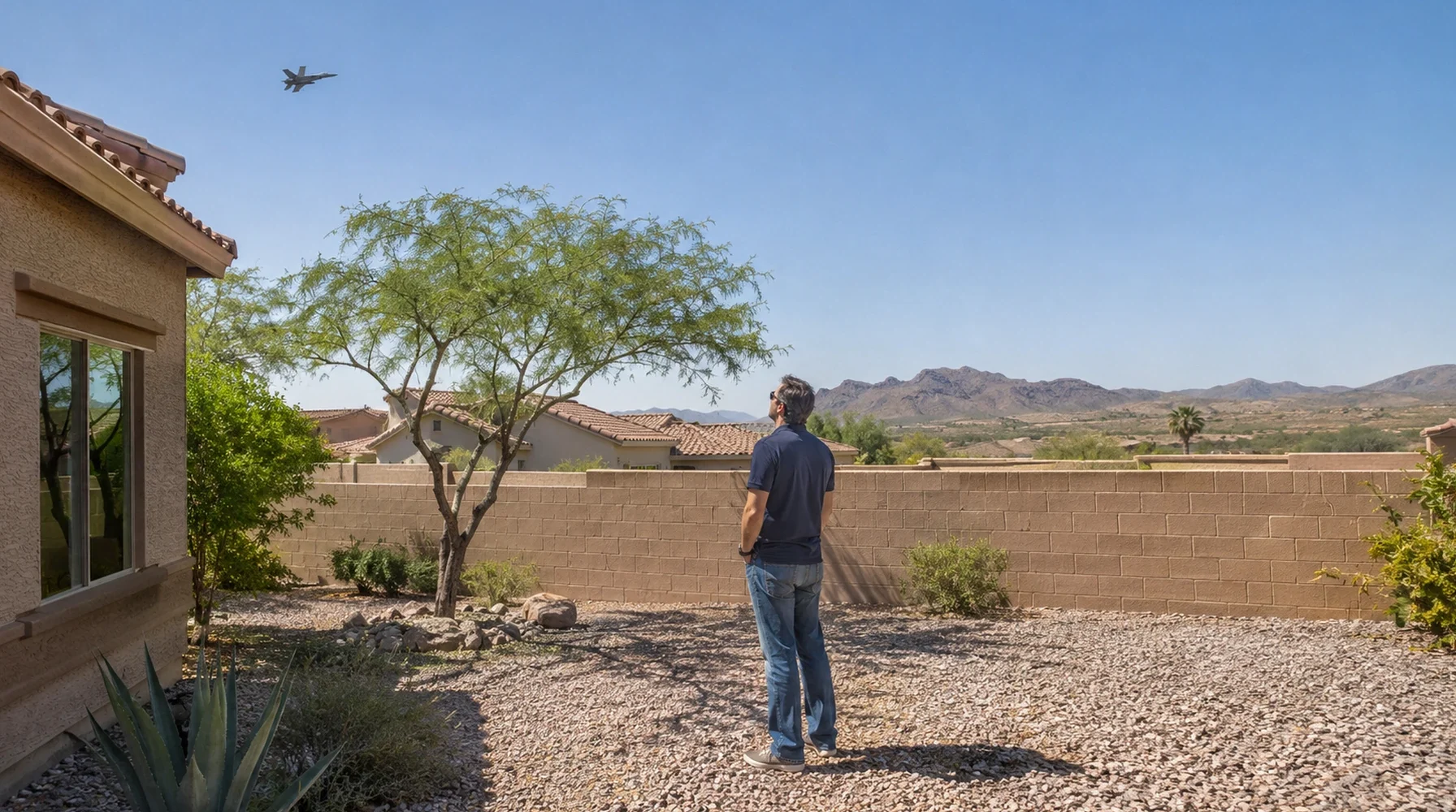
Is Luke AFB noise a deal-breaker for resale in western Glendale?
For most homes, no, but for some homes, absolutely yes. The answer depends almost entirely on where the property sits within Luke’s noise contour maps. Homes well outside the 65-decibel DNL zone generally see little to no resale impact from noise.
Homes inside the higher-decibel zones face real, documented value and use restrictions under Arizona law (A.R.S. §28-8481). The single most important step any western Glendale buyer can take is to check the specific parcel against Arizona Department of Real Estate airport boundary maps before making an offer.
You are looking at homes in western Glendale because you can get more house, larger lots, and newer construction than what is available closer to central Phoenix. You have also probably heard an F-35 take off at least once and thought, “Okay, is this actually livable? And more importantly, when I try to sell this house in seven years, will anyone buy it?” Those are the right questions to ask, and they deserve a clear answer, not a brush-off.
What Luke AFB Actually Is, and Why the Noise Exists
Luke Air Force Base occupies approximately 4,000 acres west of Glendale and is the world’s premier training base for F-16 and F-35A Lightning II fighter pilots. Virtually every F-16 combat mission flown in Afghanistan and Iraq was flown by a pilot trained at Luke. That mission, training rather than combat deployment, is the source of the noise.
Jets take off, fly training patterns, and land. They do this on a schedule that is heavy weekday daytime, lighter in the evenings, and largely quiet at night. Some weekend operations occur. The F-35 is significantly louder than the F-16 it is replacing.
That context matters because it tells you two things. First, Luke is not going anywhere. It is a strategically critical base, it has been there since World War II, and Arizona has invested heavily in protecting its operations. Second, the noise pattern is predictable enough that prospective buyers can research it rather than guess at it. Unpredictability is what kills resale value. Predictability, even of an unpleasant condition, can be priced and managed.
The Noise Contour System and Arizona Law
Noise around Luke AFB is mapped in contour zones, and Arizona law uses those zones to decide what can be built near the base and what a Glendale seller has to disclose. The FAA generates noise contour maps around military airports using Day-Night Average Sound Levels (DNL) measured in decibels. DNL is a single decibel figure that averages noise across a full day and night, so it describes the typical exposure at a location rather than one loud moment.
These maps divide the area around Luke into zones. The most commonly referenced thresholds are the 65-decibel DNL contour (moderate noise impact) and zones at 70, 75, and 80+ decibels (significantly more impact).
Arizona takes these zones seriously. Under A.R.S. §28-8481, all political subdivisions in the vicinity of a military airport must adopt land use plans and enforce zoning regulations to ensure development is compatible with the noise and accident potential generated by the base. That is why large parts of southern Glendale adjacent to Luke have been annexed and planned for industrial and logistics use rather than residential. Developments like Lincoln Logistics 303 and Woolf Logistics Center sit in the highest-noise zones because residences generally are not permitted there. Homes that are in residential-zoned areas within the noise contours either predate the current zoning or were grandfathered under specific conditions. If you own near one of these industrial areas, our post on selling near the new Sarival industrial rezone in Glendale covers that side of the picture.
For sellers, Arizona law also mandates disclosure. The Residential Seller’s Property Disclosure Statement (SPDS), the form an Arizona seller fills out describing what they know about the property, asks whether the property is located in “territory in the vicinity of a military airport” as defined by statute. This is not optional. For buyers, it means the information you need to evaluate noise risk is required to be shared as part of the disclosure process, but only after you are under contract. Doing your own research before writing an offer is always smarter than relying on disclosures alone. Our guide to the paperwork, disclosures and deadlines required to sell a Glendale home walks through where the SPDS fits.
How to Actually Check a Specific Property
You can check a specific western Glendale home against the Luke AFB noise contours yourself in a few minutes, before you write an offer. This is usually where I slow buyers down. The Maricopa County PlanNet system allows you to check any Arizona parcel against Luke AFB noise contours and military airspace. You enter the Assessor’s Parcel Number (APN), the ID number the county assigns to every property, click on the “Military” overlay, and the tool shows whether the property sits within a restricted zone and what the noise exposure level is. The Arizona Department of Real Estate also publishes airport boundary maps publicly.
Five minutes of this research before writing an offer is worth more than any disclosure document you will see after. It is also worth more than what a neighbor might tell you about what the noise “usually” sounds like. Actual DNL data is objective. Anecdotes are not.
– Dustin T, Glendale, AZ
What the Noise Actually Does to Resale Value
Luke AFB noise affects resale value in three tiers, depending on which side of the 65-decibel DNL contour a home sits. Here is how the resale story breaks down.
Homes outside the 65-decibel DNL contour (most of Glendale, most of Surprise east of Loop 303, most of Peoria) see little to no resale impact from Luke AFB itself. Buyers generally accept occasional jet noise as part of living in the West Valley, the same way residents accept traffic on major arterials or summer heat. These homes appreciate with the broader market.
Homes inside the 65-decibel contour but in residential zones, the shrinking slice of western Glendale where homes were built before current zoning tightened, face a more complicated resale picture. The buyer pool is narrower. Some buyers will not tour these homes at all. Others will tour but offer at a discount. Homes here tend to sell for less per square foot than comparable homes outside the contour, and they tend to take longer to sell. That is not a death sentence for value. The home will still sell and will still benefit from broader market appreciation, but the ceiling is lower than what equivalent homes get a few miles away.
Homes inside the higher-decibel zones (70, 75, 80+) may face genuine restrictions on use and significantly smaller buyer pools. In many cases these areas are zoned for industrial or logistics use precisely because residential uses are discouraged or prohibited. If a residential home exists there, it often has specific grandfathering or waiver conditions that a buyer’s agent must verify carefully before writing an offer.
What I Watch For Before Offering
Before a buyer makes an offer on a western Glendale home near Luke AFB, I check the parcel’s noise zone, its sales history, and what it actually sounds like during training hours. What I watch for here is the combination of those three things.
First, the parcel’s specific DNL zone as shown on the Maricopa County PlanNet map, not what the listing agent says, not what the seller says. Second, the home’s history of prior sales and days on market, pulled from MLS data. If the home sold at a discount last time and sat on the market longer than neighborhood averages, that often indicates a sustained noise-driven discount. Third, the actual experience of being at the property during peak training hours, typically weekday mid-mornings and early afternoons. Visit the home during those hours, sit outside for 20 minutes, and see whether you could live with what you hear.
The Long-Term Picture
Over the long term, Luke AFB noise near western Glendale is more likely to stay the same or get louder than to get quieter, while broader West Valley growth keeps lifting home values. The demand for pilot training at Luke is not decreasing. If anything, the F-35 expansion has increased activity, and the base’s strategic role is stable. Any buyer purchasing near Luke is essentially committing to the current noise environment or louder, not quieter.
On the other hand, West Valley growth has accelerated dramatically, and residential demand in Glendale, Peoria, and Surprise continues to rise. Broader market lift generally helps all homes, including those near Luke. A home that sells at a 5-10% discount compared to non-noise-affected comps today is likely to sell at a similar relative discount in 7-10 years. That means the absolute dollar amount of your equity still grows with the market, even if the discount percentage remains. The same logic applies to other noise sources in the area, which our post on how Loop 303 growth affects Surprise traffic noise and resale looks at.
This is the nuance that gets lost in “yes or no” answers about Luke AFB noise. The noise is real. The disclosure is mandatory. The resale impact is measurable but not catastrophic for most affected homes. The key is understanding which category your specific property falls into before you commit.
Frequently Asked Questions About Luke AFB Noise and Glendale Resale
How do I find out if a Glendale home is in a Luke AFB noise zone?
Use the Maricopa County PlanNet system with the property’s Assessor’s Parcel Number (APN) and activate the Military overlay. Arizona Department of Real Estate also publishes airport boundary maps.
What is the 65-decibel DNL contour?
DNL is a decibel figure that averages noise across a full day and night. The 65-decibel DNL contour marks moderate noise impact around Luke, and the zones at 70, 75, and 80+ decibels carry significantly more impact.
Does Luke AFB noise lower home values in western Glendale?
Homes outside the 65-decibel contour see little to no resale impact. Homes inside it tend to sell for less per square foot and take longer to sell, and homes in the 70+ decibel zones may face use restrictions and much smaller buyer pools.
Is the Luke AFB noise required to be disclosed by sellers?
Yes. Arizona law and the Residential Seller’s Property Disclosure Statement require sellers to disclose if the property is located in “territory in the vicinity of a military airport” as defined by A.R.S. §28-8481.
Can I insulate or soundproof my home to reduce Luke AFB noise?
Soundproofing can help, but it typically addresses indoor noise only and cannot fully eliminate higher-decibel jet noise. Outdoor use of the property will still be affected by overflights.
Does Luke AFB operate at night?
Night operations exist but are typically limited. The bulk of training occurs weekday daytimes. Some evening and occasional weekend operations do happen.
When should I visit a home to hear the Luke AFB jet noise?
Visit during peak training hours, typically weekday mid-mornings and early afternoons. Sit outside for 20 minutes and see whether you could live with what you hear.
Will Luke AFB get quieter in the future?
Unlikely. Demand for pilot training at Luke is not decreasing, and the F-35, which is significantly louder than the F-16, has increased activity. Buyers near Luke are committing to the current noise environment or louder.
Is new construction allowed in Luke’s noise zones?
Residential new construction is restricted or prohibited in the higher-decibel zones under A.R.S. §28-8481 and local zoning. Industrial, logistics, and some commercial uses remain permitted. Existing residential structures may have grandfathering rights.
The Bottom Line
Luke AFB noise is not a universal deal-breaker for western Glendale resale, but it can be a specific deal-breaker for specific properties. The difference between “manageable” and “problematic” is knowable before you write an offer. Check the parcel against the noise contours, visit during peak training hours, pull the MLS sale history, and read the SPDS carefully. A home a few blocks outside the 65-decibel contour may look identical to one a few blocks inside it, but the resale arcs are different. Buying with clear eyes protects your equity. Guessing usually does not.
Knowing which side of that line a home sits on before you commit is how you make your move with clarity and confidence. It is the same due diligence I walk through with every buyer looking at homes near Luke, so the decision rests on the parcel’s real numbers rather than a guess.
If you want to talk through how Luke AFB noise affects a specific western Glendale home you are considering, let’s chat. You can reach me, Kasandra Chavez with the Chavez Dream Home Team, at 928-910-7401, or grab a time on my calendar.