


Are Sun City and Sun City West HOA Fees Worth It?
How do Sun City and Sun City West recreation fees work, and are they worth it for the amenities you get?
In Sun City and Sun City West, your primary financial commitment isn’t a traditional monthly HOA (homeowners association) fee, but a mandatory annual assessment, currently ranging from approximately $600 to $680 per year. These funds provide access to recreation centers, fitness facilities, pools, and social clubs. Additionally, buyers pay a one-time Asset Preservation or Improvement Fee of $5,000 to $5,400+ at purchase to fund long-term facility maintenance and upgrades.
Whether these fees represent good value depends on how the community’s infrastructure aligns with your lifestyle priorities in retirement. For many buyers, the challenge is shifting from a “pay-per-use” mindset to a “system-protection” mindset.
In the West Valley’s 55+ communities, the conversation around “HOA fees” is often misunderstood. Unlike traditional neighborhoods where monthly HOA fees cover exterior maintenance and amenities, Sun City and Sun City West operate on a different model: one designed to preserve the massive recreational infrastructure while keeping recurring costs manageable.
Most buyers enter this conversation focused on calculating exact usage value. They want to know if they’ll use the pools enough times to justify the cost, or whether they’ll golf frequently enough to make the fees worthwhile. This is usually where I help buyers reframe the question entirely. The fees aren’t just about personal use; they’re about protecting a system that maintains property standards and ensures long-term community appeal.
What Your Annual Recreation Assessments Actually Cover
In Sun City and Sun City West, the annual recreation assessment pays to run the shared recreation system, and it gives you access at resident rates rather than free use of everything. It’s important to distinguish between “access” and “membership.” In Sun City and Sun City West, your annual assessment funds the operational structure that keeps the community’s massive footprint functional.
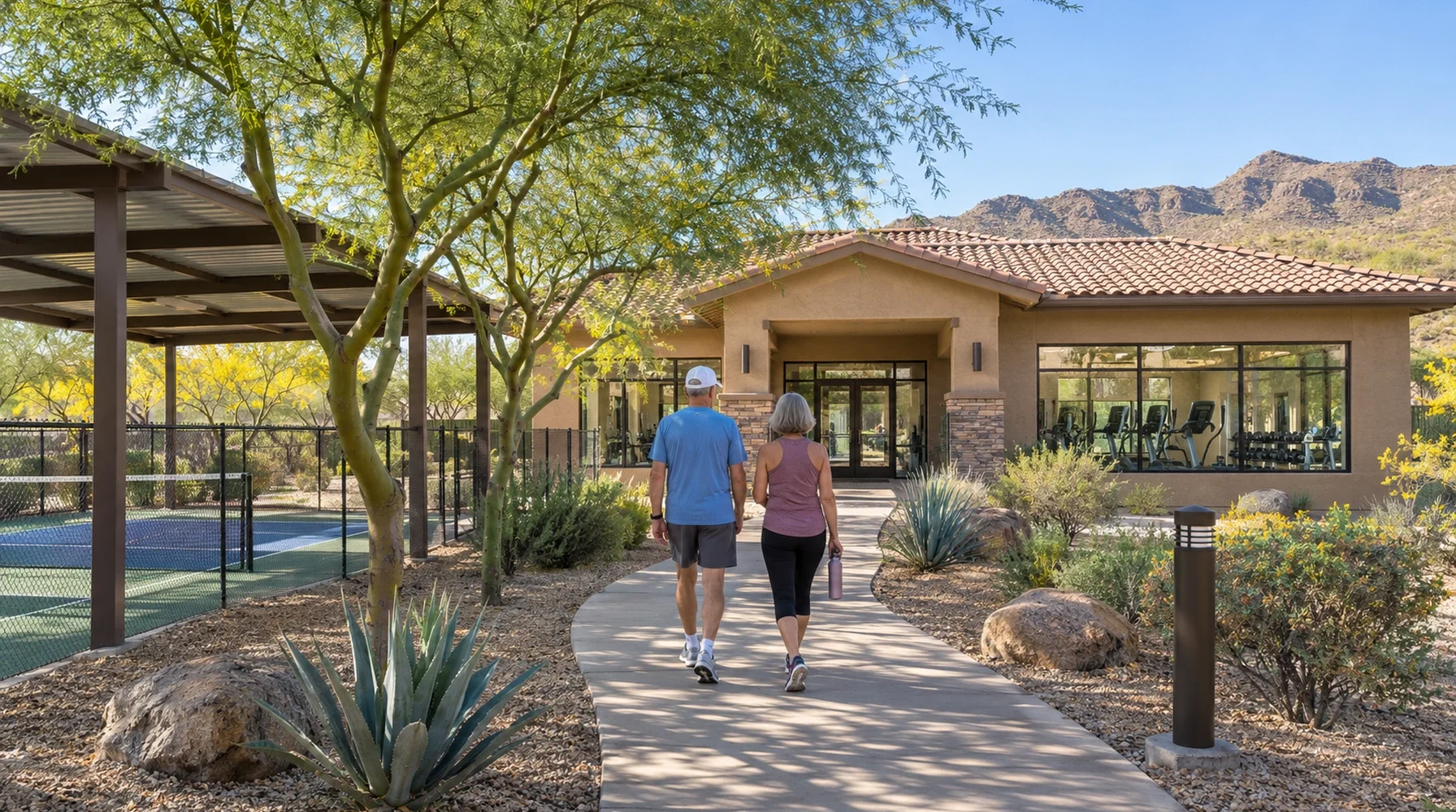
Your annual recreation fees (approximately $600 to $680 per year, depending on the community) typically cover the operation of multiple recreation centers, swimming pools, tennis and pickleball courts, fitness facilities, common area landscaping throughout the community, and coordination of hundreds of social clubs and activities. According to Recreation Centers of Sun City West data, these fees grant you the right to use facilities at resident rates, but it’s a common misconception that all amenities are “free.”
Golf, for example, requires additional fees. Most residents choose between a pay-per-round model or a separate annual golf pass (currently priced around $2,800+) depending on their frequency of play. The annual recreation fee gives you access to the courses at reduced resident rates, but golf is not included in the base assessment. What that means for your budget: if golf is a big part of your plans, price it as its own line item on top of the recreation fee.
Beyond the amenities themselves, these fees protect what I call the “social infrastructure.” You aren’t just paying for a pool; you’re paying into a system that ensures high-level maintenance and property standards without requiring constant individual coordination. This model has helped Arizona become one of the nation’s top retirement destinations, specifically because of the managed, amenity-rich environment these communities provide. If you’re still weighing the region as a whole, our look at whether Phoenix and the West Valley are still a good place to retire covers the bigger picture.
– Ashley Palomo
The Upfront Investment: Understanding the Asset Preservation Fee
Sun City and Sun City West both charge buyers a one-time fee at closing, separate from the annual recreation fee. One detail often missed in early research is the one-time “buy-in” fee. To ensure the long-term health of the community without spiking annual dues, both Sun City and Sun City West charge an Asset Preservation or Improvement Fee at the time of purchase.
In Sun City, this is called the Preservation and Improvement Fee and currently stands at approximately $5,000. In Sun City West, it’s the Asset Preservation Fee at approximately $5,400. This is a one-time charge paid at closing, typically by the buyer, though buyer and seller can negotiate who pays it.
This is a strategic investment, not just another closing cost. The fee ensures that recreation facilities remain modern and competitive without requiring dramatic increases to annual assessments. It funds major capital improvements (roof replacements on recreation centers, pool resurfacing, fitness equipment upgrades, and facility expansions), all of which directly protect your home’s resale value.
Here’s an important provision: if you already own a home in Sun City or Sun City West and decide to sell it to purchase another property within the same community, you won’t pay the asset preservation fee twice. If you sell your original home within one year of purchasing your new property, you can apply for a refund of the fee since you already paid it with your initial purchase. This makes it easier for residents who want to move to a different neighborhood within the community or upsize to a larger home.
What I help buyers understand is that this fee should be factored into your initial closing costs from the beginning. It’s not optional, but it’s also not recurring. You pay it once, and it protects the infrastructure for the entire time you live there. If you haven’t settled on which of the two communities fits you, our comparison of Sun City and Sun City West is a useful next read.
Evaluating Whether the Model Aligns with Your Actual Lifestyle
Whether Sun City or Sun City West recreation fees are worth it for you depends more on how you live today than on the amenity list. The 55+ model requires a shift in how you think about daily structure and community involvement. I typically ask buyers to look at their current habits rather than their “retirement dreams.”
If you’re already active: The bundled access to fitness facilities, pools, and social clubs will likely save you money compared to private gym memberships and separate club dues. Many residents find that the annual recreation fee of $600 to $680 breaks down to roughly $50 to $57 per month, significantly less than a typical gym membership alone, and that doesn’t even account for pool access, tennis courts, pickleball facilities, and social programming.
If you prefer solitude or minimal community involvement: The value proposition shifts entirely. Even if you never step foot in a recreation center, the enforced property standards and maintained common areas help Sun City homes consistently hold value. Research indicates that homes in well-managed communities often sell for 4% to 6% more than comparable non-HOA homes because the visual appeal and infrastructure maintenance of the neighborhood are guaranteed.
What I watch for here is whether buyers are evaluating the community based on how they actually live versus how they imagine retirement should look. The amenities have the most value when they align with patterns you’ve already established, not behaviors you hope to develop once you move in. Living in a 55+ community also comes with rules, and our guide to reading Sun City West CC&Rs and age-restriction rules explains what to check before closing.
Comparing the Total Cost of Ownership Across Housing Types
Not all neighborhoods in Sun City and Sun City West are structured the same way, and understanding the differences matters when calculating your actual monthly housing costs.
Single-family homes: You’ll pay the annual recreation fee ($600 to $680 per year) and the one-time asset preservation fee at purchase, but most single-family homes do not have an additional monthly HOA fee. You’re responsible for your own exterior maintenance, landscaping, roof repairs, and property upkeep.
Condos, townhomes, and “twin” (duplex) homes: In addition to the annual recreation fee and the one-time asset preservation fee, many of these properties have a separate monthly HOA fee, often ranging from $150 to $300+ per month. This fee typically covers exterior building maintenance, roof repairs, landscaping of your individual unit, trash collection, and sometimes additional amenities specific to that neighborhood.
The goal isn’t necessarily to find the lowest fee structure; it’s to find the structure that provides the most “decision protection” for how you want to live. A single-family home with no monthly HOA fee might seem attractive, but if you don’t want to manage yard work, roof maintenance, or exterior paint, the convenience of a condo with a $200 monthly HOA fee might represent better long-term value for your time and energy.
This is where I help buyers look beyond the immediate dollar amount to the actual lifestyle trade-offs. What do you want to be responsible for? What do you want handled for you? The fee structure should match those priorities.
How Recreation Fees Affect Your Monthly Budget and Long-Term Value
When evaluating whether to buy in Sun City or Sun City West, the annual recreation fee needs to be factored into your total housing cost, along with the one-time asset preservation fee in your closing budget.
Let’s look at a real example: If you’re comparing a $250,000 home in Sun City with a $650 annual recreation fee and a $5,000 asset preservation fee to a $250,000 home in a traditional Phoenix neighborhood with no HOA or recreation fees, here’s what the numbers actually look like.
Year 1: The Sun City home costs $5,650 more ($5,000 one-time fee + $650 annual fee). Years 2 to 10: The Sun City home costs $650 more per year (or about $54 a month). 10-year total: $11,500 in recreation and preservation fees. Most of the first-year gap is the one-time fee; after that, the ongoing difference works more like a modest monthly bill.
For some buyers, that feels like a significant ongoing expense. For others, it represents reasonable value because they’re getting access to maintained recreation centers, pools, fitness facilities, and social infrastructure they would otherwise have to find and fund separately, often at higher costs.
The resale consideration works differently than in traditional HOA communities. According to Foundation for Community Association Research data, homes in well-managed HOA communities represent over $12.9 trillion in combined value nationwide, and properties with active facility maintenance typically see more stable appreciation patterns. Sun City and Sun City West have maintained strong resale appeal for decades specifically because the asset preservation fees fund continuous facility upgrades without creating deferred maintenance issues.
However, if you’re planning a shorter-term stay (3 to 5 years), the upfront asset preservation fee becomes more significant. You’re paying $5,000 to $5,400 to access a system you won’t use long enough to fully benefit from the infrastructure protection it provides. Buyers who stay 10 to 15+ years benefit most because they’re spreading that one-time fee across many years of use while enjoying consistently maintained facilities and protected property values.
When the Sun City Model Makes Sense and When It Doesn’t
The Sun City recreation fee model makes sense if you value:
- Convenience over coordination: You want amenities ready and waiting without managing memberships, scheduling, or coordinating access to multiple facilities across town. Everything is centralized within the community.
- Property stability and visual standards: You want the peace of mind that your neighbor’s property maintenance will match community standards, protecting your investment. The recreation fees fund common area upkeep that ensures the entire community maintains its appeal.
- Long-term value and infrastructure protection: You plan to stay long enough (typically 10+ years) for the one-time asset preservation fee to be offset by years of facility use and the long-term property value protection that well-maintained amenities provide.
- Simplified budgeting with predictable costs: The annual recreation fee increases modestly over time and is voted on by the community governing board, making it more predictable than private gym memberships or country club dues that can increase unexpectedly.
The Sun City model may not fit if any of these describe you:
- Full control of spending: You prefer complete autonomy over every dollar spent and want the flexibility to opt out of amenities you don’t use.
- Little use of shared amenities: You rarely or never use shared recreational facilities and don’t value the property protection aspect enough to justify the cost.
- A short-term stay: You’re planning a short-term stay (under 5 years) where the upfront asset preservation fee won’t be offset by long-term use and value.
- No ongoing community fees: You want to avoid any ongoing community fees and prefer a traditional neighborhood with no mandatory assessments.
If that last point describes you, our post on HOA versus non-HOA neighborhoods in the West Valley walks through the other side of the trade-off.
Frequently Asked Questions About Sun City and Sun City West Recreation Fees
What’s the difference between the annual recreation fee and the asset preservation fee?
The annual recreation fee ($600 to $680 a year) is a recurring charge that covers day-to-day operations of recreation centers, pools, fitness facilities, and social programming. The asset preservation fee ($5,000 to $5,400) is a one-time charge paid at closing that funds major capital improvements.
Do I have to pay the asset preservation fee again if I move to a different home within Sun City?
No. If you sell your current Sun City home and purchase another property within the same community within one year, you can apply for a refund of the asset preservation fee since you already paid it with your initial purchase.
Is golf included in the annual recreation fee?
No. The annual recreation fee provides access to golf courses at resident rates, but you’ll pay separately for each round or purchase an annual golf pass (currently around $2,800+) if you play frequently.
Can recreation fees increase over time?
Yes, the annual recreation fee can increase to cover rising operational costs, facility improvements, or expanded programming. Fee increases are voted on by the recreation center governing board and typically happen on an annual basis.
Are recreation fees and asset preservation fees tax-deductible?
In most cases, recreation fees and asset preservation fees for a primary residence are not tax-deductible. However, if you rent out the property or use it for business purposes, a portion may be deductible. Consult a tax professional for guidance specific to your situation.
How much is the asset preservation fee in Sun City and Sun City West?
In Sun City, the Preservation and Improvement Fee is approximately $5,000. In Sun City West, the Asset Preservation Fee is approximately $5,400. Either way, it is a one-time charge the buyer pays at closing.
Do condos and townhomes in Sun City have a monthly HOA fee?
Many do. On top of the annual recreation fee, many condos, townhomes and twin homes carry a separate monthly HOA fee, often $150 to $300+, that typically covers exterior maintenance, roof repairs, landscaping and trash.
How long should I plan to stay in Sun City for the fees to make sense?
Buyers who stay 10 to 15+ years benefit most, because the one-time asset preservation fee is spread across many years of use. On a 3 to 5 year stay, that upfront fee weighs much more heavily.
Making the Decision with Confidence
The question isn’t whether Sun City recreation fees are objectively “high” or “low”; it’s whether the managed environment, facility access, and property protection they provide align with how you want to live in retirement.
If you value access to recreation facilities, fitness centers, pools, and social programming without having to coordinate memberships or manage maintenance yourself, the fees represent a strategic and reasonable trade-off. If you prefer complete autonomy, minimal community involvement, and want to avoid any mandatory ongoing assessments, a traditional neighborhood might be a better fit.
What matters most is that the decision is based on your actual lifestyle priorities and long-term plans, not on assumptions about what retirement should look like or pressure to justify every dollar of the fees. The communities that work best are the ones where the fee structure and amenity access support how you’re already living, not the ones that require you to change your habits to feel like you’re getting value. Weighing the fees against how you really live is how you make your move with clarity and confidence.
If you want to talk through how Sun City or Sun City West recreation fees fit your budget and your plans for retirement, let’s chat. You can reach me, Kasandra Chavez with the Chavez Dream Home Team, at 928-910-7401, or grab a time on my calendar.