


Union Park at Norterra vs. Stetson Valley: Walkability or Space?
As Union Street at Norterra fills up with brands like CAVA, Shake Shack and Firebirds, with First Watch and Tropical Smoothie still to come, will that walkable lifestyle justify paying more for a smaller home in Union Park at Norterra compared with a larger home in Stetson Valley?
It comes down to how much you will actually use the walkable lifestyle. Union Park at Norterra in north Phoenix is built so you can walk or bike to the Union Street restaurants, and you pay more per square foot for that everyday convenience on foot, while Stetson Valley gives you more square footage and yard at a lower price per foot in a drive-everywhere layout. If walking to coffee and dinner is something you will genuinely do several times a week, the premium can be worth it; if you mostly want maximum space for your money, Stetson Valley is the stronger value.
Price per square foot is simply the sale price divided by the home’s interior size, and it is the cleanest way to see what you are paying for. A higher number at Union Park means part of your money is buying location and lifestyle rather than rooms.
This is one of the most personal trade-offs in north Phoenix right now, and the new retail makes it feel urgent. It is easy to fall for the idea of strolling to dinner and assume that lifestyle is worth any price. But “walkable” only pays off if you actually walk, and “more space” only matters if you will use it. The communities are close to each other geographically yet built around opposite philosophies, so the real question is not which is better in the abstract; it is which one matches how your household genuinely lives day to day. This is usually where I slow buyers down, because the honest answer often has less to do with the homes and more to do with your habits.
What “Walkable” Actually Means at Union Park
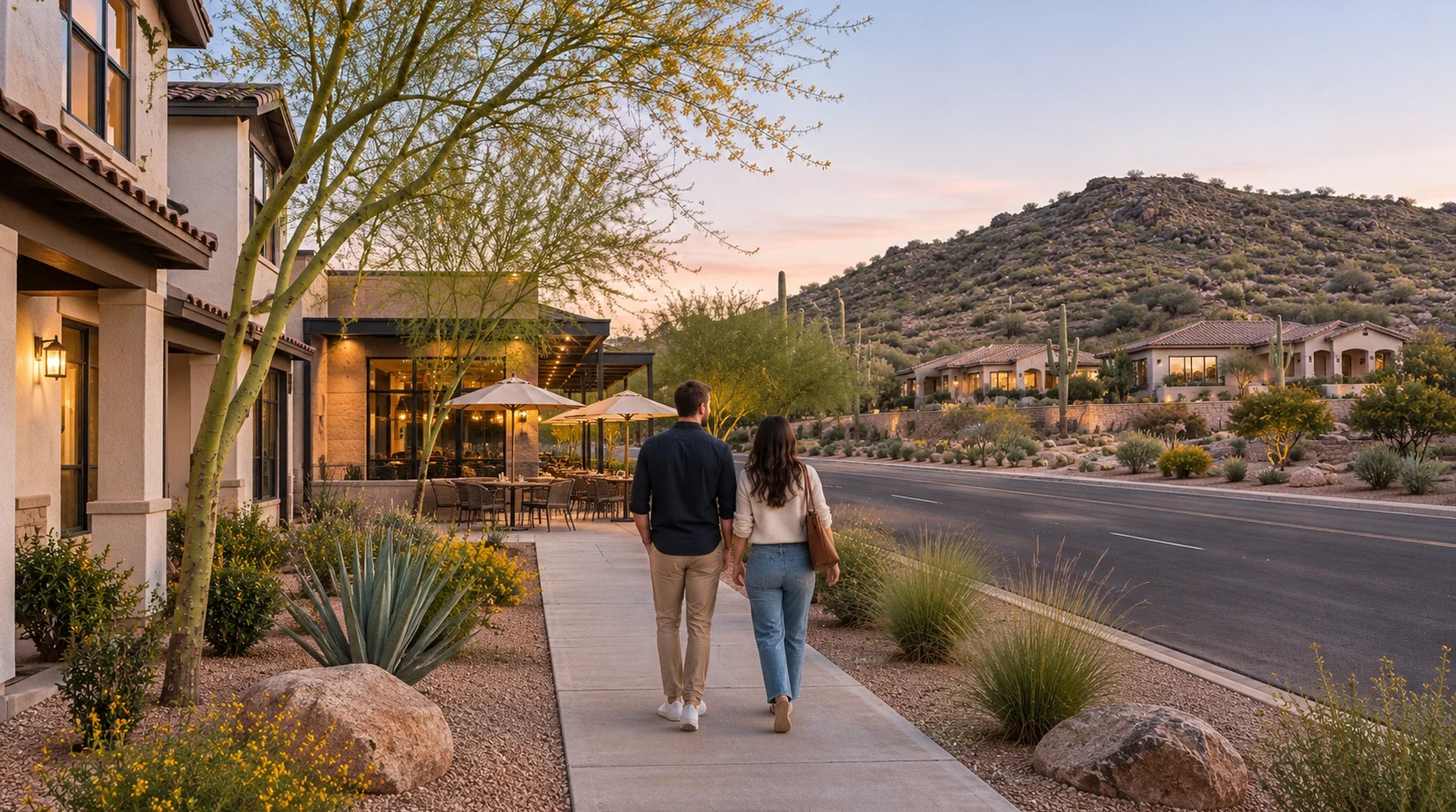
At Union Park at Norterra, walkable means homes placed so you can reach real restaurants on foot. Union Park was designed from the start around a walkable, in-town feel: tighter streetscapes, gathering spaces, and homes positioned so residents can walk or bike to retail rather than drive to it.
The new Union Street at Norterra development is what gives that design teeth: it’s a mixed-use retail project where confirmed tenants who have signed leases include Shake Shack, CAVA, First Watch, Tropical Smoothie and Firebirds Wood Fired Grill, most slated to open over the course of 2026. That is the difference between a community that says it is walkable and one where there is actually somewhere to walk to.
The trade-off baked into that design is lot size. Walkable, in-town communities achieve their density and street life partly by building on smaller lots, so the premium you pay at Union Park often buys location and lifestyle rather than square footage or yard. For some buyers that is exactly right; for others it is the deal-breaker. If you are looking at a brand-new home, David Weekley is still building at Union Park, while Cachet Homes and Ashton Woods are down to their final homes, so most of your choices will come from one builder or from resale.
What I watch for here is buyers paying the walkability premium for a lifestyle they admire more than they will live. Be honest with yourself: if you picture walking to a Saturday breakfast and an evening coffee and it makes you genuinely happy, the premium is buying you something real. If you suspect you would still drive most places out of habit, you may be paying for a brochure. For a broader frame on weighing these lifestyle factors against one another, this guide on how to weigh commute, amenities, and lifestyle when choosing where to live is a useful starting point.
What You Give Up, and Gain, in Stetson Valley
In Stetson Valley you gain a larger home, a bigger lot and trail access for your money, and you give up walking to dinner. Stetson Valley sits a short distance west of Norterra in north Phoenix, tucked against the Deem Hills, and it is built on the opposite premise from Union Park: more traditional single-family neighborhoods with larger homes, bigger lots, and a quieter, drive-everywhere rhythm.
Homes in Stetson Valley generally give you noticeably more square footage and yard for the money than a comparably priced home in Union Park, along with quick access to trails and preserve land right at the community’s edge. What that means for you is simple: if your weekends happen at home or on a trail, the extra space is something you use every day.
The trade-off is convenience on foot. Daily errands and dining in Stetson Valley mean getting in the car, because the nearby retail centers are a short drive rather than a short walk. That is not a flaw; for plenty of buyers, a larger home, more privacy, and a two-minute drive to the things they need is precisely the lifestyle they want, and they would find a tighter walkable lot a downgrade.
The clean way to frame it: Union Park sells proximity and street life at the cost of space, while Stetson Valley sells space and quiet at the cost of walking. Neither is objectively superior. If you are also weighing condition and how much home you take on, this look at trading move-in condition against other priorities and this overview of what it costs to buy in this market right now can help you keep the value comparison honest. Our guide to whether Stetson Valley is a good community to buy in goes deeper on the neighborhood itself.
– Renee A, Phoenix, AZ
Does Walkability Hold Its Value?
Genuine, well-executed walkability like Union Park’s tends to hold buyer demand over time, because it is hard to replicate. The fair question behind “is it worth paying more” is whether the walkability premium holds up or fades once the novelty of new restaurants wears off. You can build a bigger house anywhere, but you cannot easily manufacture a community where dinner, coffee, and a grocery run are a short walk from the front door. When a walkable design is paired with real, leased retail rather than promised retail, the lifestyle has staying power.
The risk to weigh is execution and timing. Retail that is announced but not yet open is a promise, not an amenity, so it is worth knowing which tenants have actually signed and which are already serving customers before you pay for the finished vision. The Norterra area sits within the City of Phoenix’s North Gateway village, which the city describes as a regional employment center with master-planned communities, and the city’s North Gateway Village Core Plan lays out the pedestrian-oriented, mixed-use vision the area is being built toward. That is useful context for judging how durable the walkable lifestyle is likely to be.
For resale value, the practical test is the buyer pool. A smaller walkable home appeals strongly to a specific, growing set of buyers who prioritize lifestyle and convenience; a larger Stetson Valley home appeals to a broader set who prioritize space. Both pools are real in north Phoenix, which is part of why neither choice is a clear mistake. Our post on whether walkability adds resale value walks through that question in more detail.
Matching the Trade-Off to How You Actually Live
The choice between Union Park at Norterra and Stetson Valley gets much easier once you stop comparing the communities and start auditing your own week. Picture a normal seven days: how often would you really walk to retail versus drive, how much of your time is spent at home in the space you are paying for, and whether a yard is something you will use or just maintain. Those answers point you to the right side faster than any feature list.
A few honest gut-checks help sort out which side of the trade-off fits your household:
- Working from home: If your house is your whole world most days, square footage earns its premium and Stetson Valley usually fits better.
- Out and about often: If you crave a sense of place and easy errands on foot, the walkable lot at Union Park earns its premium instead.
- Stretching the budget: If you are reaching to afford the smaller walkable home, ask whether you would resent the smaller space more than you would enjoy the walk.
- Using the yard: If a yard would mostly be something to maintain rather than enjoy, the smaller lot at Union Park costs you less than it seems.
At this stage, I help clients narrow their focus to the two or three lifestyle realities that actually drive satisfaction, not the ones that sound appealing in a sales center. Get specific about your real habits, weigh them against the price difference, and the choice between proximity and space usually stops feeling like a toss-up.
Frequently Asked Questions About Union Park at Norterra and Stetson Valley
What restaurants are coming to Union Street at Norterra?
Confirmed tenants with signed leases include Shake Shack, CAVA, First Watch, Tropical Smoothie and Firebirds Wood Fired Grill, most slated to open over the course of 2026.
Is Union Park at Norterra actually walkable?
Yes. It was designed around walkability, with homes set within walking or biking distance of retail. The adjacent Union Street at Norterra development adds dining within easy reach of the community.
Why are homes in Stetson Valley larger for the price?
Stetson Valley is a more traditional suburban community built on larger lots, so you generally get more square footage and yard per dollar. The trade-off is that daily errands and dining mean driving rather than walking.
Does paying more for a walkable home make sense for resale?
Genuine, well-executed walkability tends to hold demand because it is hard to replicate, especially when paired with leased retail. The key is buying for retail that has actually signed on, not retail that has only been announced.
Where is Stetson Valley compared with Union Park at Norterra?
Both are in north Phoenix. Stetson Valley sits a short distance west of Norterra, tucked against the Deem Hills, so the two are close on a map but built around opposite ideas: space versus walkability.
Are builders still selling new homes in Union Park at Norterra?
Union Park still has builders selling new homes in some phases, and many other choices there are resale homes. Ask each sales office what is available before you compare.
What does price per square foot tell me when comparing the two?
It is the price divided by the home’s interior size. A higher figure at Union Park means part of the price buys location and walkability, while a lower figure in Stetson Valley means more space for each dollar.
How do I decide between walkability and more space?
Audit a normal week. If you would really walk to coffee and dinner several times a week, Union Park’s premium buys something real. If most of your life happens at home or in the car, Stetson Valley’s space is the better fit.
The Bottom Line
There is no universal winner between Union Park at Norterra and Stetson Valley; there is only the version that fits your week. Union Park sells proximity, street life, and walk-to-dinner convenience at the cost of space; Stetson Valley sells square footage, yard, and quiet at the cost of walking. The open Union Street restaurants make Union Park’s pitch more real than it used to be, but the premium only pays off if you will actually live the walkable lifestyle.
Audit your real habits, weigh them honestly against the price difference, and let how you live, not how you would like to imagine living, make the call. That is the kind of clear, personalized guidance I bring to every buyer, so you can make your move with clarity and confidence.
If you want to talk through how the walkability and space trade-off fits your specific situation, let’s explore your options. You can reach me, Kasandra Chavez with the Chavez Dream Home Team, at 928-910-7401, or grab a time on my calendar.