

Will TSMC Make North Phoenix Feel Too Industrial?
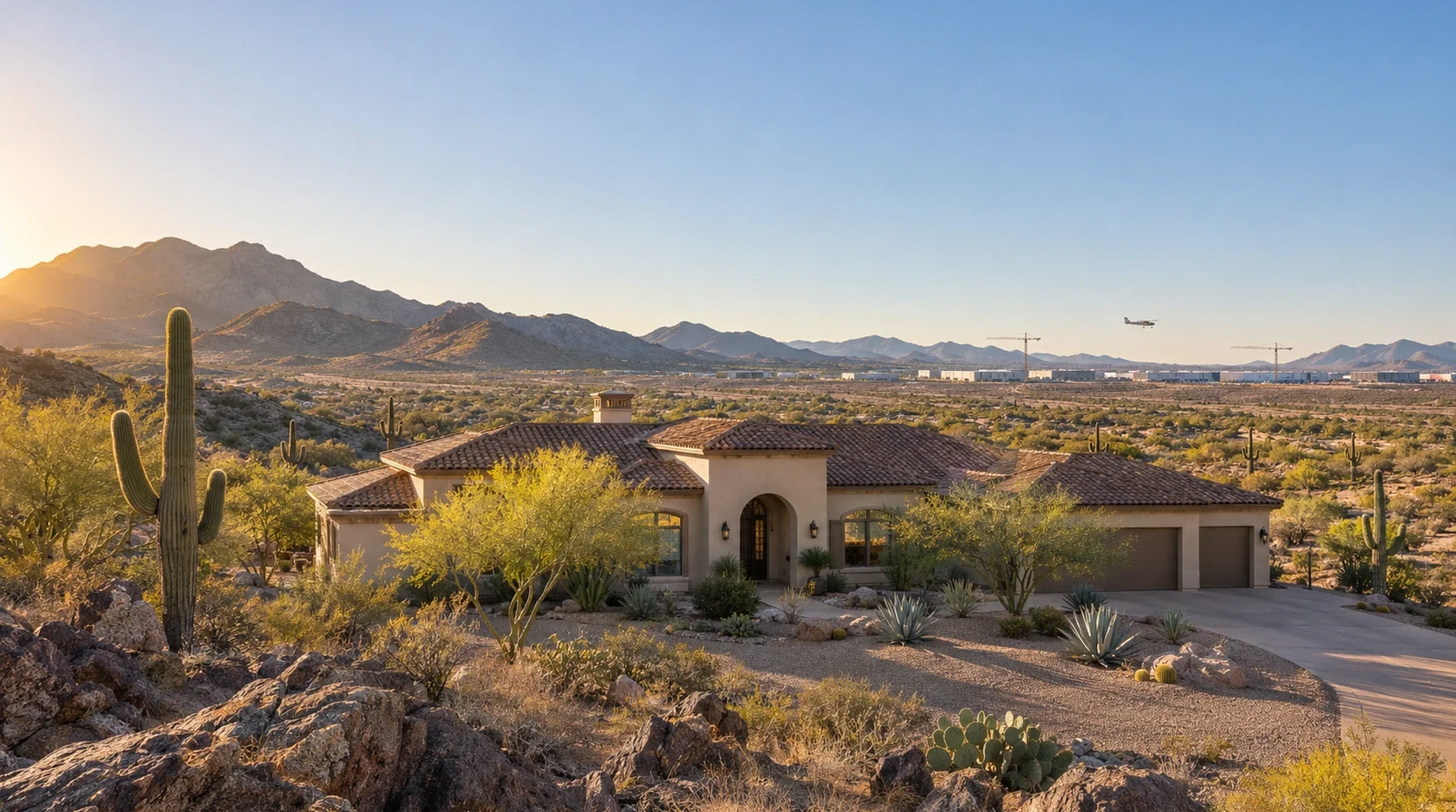
As TSMC’s Phase 3 investment ramps up, will homes in Deer Valley feel “too industrial,” and should I instead focus on Tramonto or Desert Hills if I want more of a residential feel long term?
If a quieter residential feel and long-term lifestyle character matter most to you, Tramonto and Desert Hills are typically the safer bets than Deer Valley neighborhoods near the airport and the industrial pockets along I-17 and Loop 101. Phase 3 brings continued construction, industrial-scale operations, and a denser supplier ecosystem that genuinely changes how the Deer Valley submarket feels day-to-day. That doesn’t make Deer Valley a bad place to own, but it does make it a different kind of place than Tramonto or Desert Hills, and the difference compounds over a long hold.
This stage is usually where I slow buyers down. A “residential feel” is one of those things that’s easy to assume you have today and harder to keep when the surrounding industrial footprint grows.
What TSMC Phase 3 Actually Means for the Submarket
TSMC Phase 3 is the third chip plant (a “fab,” short for fabrication plant) on TSMC’s north Phoenix campus, which sits near the intersection of Loop 303 and Interstate 17. The first fab is producing chips with 4nm process technology; the second fab’s construction was completed in April 2026 with equipment installation scheduled and commercial production targeted for the second half of 2027 on 3nm; the third fab broke ground in April 2025 and is targeting next-generation 2nm and A16 process technology, TSMC’s names for its newest and smallest chip-making processes. TSMC’s Arizona commitment stands at $165 billion across six fabs, two advanced packaging facilities, and a research and development center. The campus covers more than 2,000 acres and has grown into a multi-fab cluster, not the single facility that was originally announced in 2020.
What that means for residential character in Deer Valley and along the I-17 corridor is straightforward: continued industrial-scale construction for years, ongoing supplier development on industrial parcels, more daily truck and worker traffic, and a denser industrial-employment footprint along I-17. None of this makes the area uninhabitable. Many people will choose to live close to high-paying employment for the commute math. It does change the texture of a neighborhood from “residential suburb that happens to be near jobs” to “residential pocket inside an industrial-and-employment district.”
How Deer Valley Airpark Adjacency Specifically Affects a Home
Deer Valley Airpark is a busy general aviation airport in north Phoenix, meaning it serves private, training, and business aircraft rather than airline flights. Homes directly adjacent to the flight path experience daily aircraft noise, with patterns that can shift depending on wind, weather, and operational schedules. For some buyers, that noise sits in the background and becomes routine. For others, it never fully fades.
Add the industrial growth around the airpark and the Interstate 17 and Loop 101 interchange, with heavy construction trucks, supplier traffic, and large-scale facility operations, and the cumulative “feel” of a Deer Valley neighborhood is meaningfully different from a typical north Phoenix suburb. One example: KTAR reported in December 2025 that an 808,000-square-foot, four-building industrial park is under construction at 23rd Avenue and Beardsley Road, near I-17 and Loop 101, with its developer saying the area’s momentum is driven in part by TSMC and related industries. The TSMC campus itself sits farther north, near Loop 303, so what Deer Valley absorbs is the supplier and logistics growth that follows the fabs. The most honest test is to spend a weekday morning around any prospective home with your windows down: listen, look at traffic patterns, watch what’s happening on adjacent parcels. The marketing photos won’t tell you what a Tuesday at 7:15 a.m. actually sounds like.
For buyers focused specifically on the industrial-feel question, this Peoria and Phoenix commute neighborhood guide covers how the corridor’s neighborhoods compare on drive times and daily routine before you narrow to a specific area, and our Deer Valley Airpark area vs. Desert Hills and Tatum Ranch buyers guide looks at noise and growth more closely.
What Tramonto Offers
Tramonto sits in north Phoenix along the I-17 corridor north of Happy Valley Road, near Carefree Highway, much closer to the New River area and well north of the heaviest Deer Valley industrial activity. It’s a more established residential master plan with a desert backdrop, lower-density feel, and a community character that’s been settling in for years rather than still emerging. Tramonto sits on the opposite side of I-17 from the TSMC campus: close enough for about a 15-minute drive, but not right next to it. You’re on I-17, the connector that defines the whole corridor, without sitting inside the Deer Valley industrial footprint or under the airpark’s flight paths.
For a TSMC engineer or supplier-side professional who wants residential character for the family and home life while keeping the commute manageable, Tramonto often hits a better balance than Deer Valley-adjacent inventory. The trade is usually a longer drive south toward central Phoenix in exchange for a quieter neighborhood feel and less industrial-influenced surroundings. Because the campus is only about 15 minutes away, it is still worth watching what is planned on the land around it, not just the street you would live on.
– Dustin T, Glendale, AZ
What Desert Hills Offers
Desert Hills sits north of the Phoenix city limits and south of Anthem, along the I-17 corridor, in a much more rural and lower-density part of north Phoenix. The character is closer to “semi-rural high desert” than “north Phoenix suburb”: larger lots, more space between homes, fewer commercial intrusions, and a meaningfully different surrounding density. For buyers who specifically want to escape the suburban grid and step into more open desert, Desert Hills delivers. Like Tramonto, much of Desert Hills sits on the opposite side of I-17 from the TSMC campus, close enough for roughly a 15-minute drive from many lots without being next to it.
The trade is real: a commute to TSMC that varies a lot by lot, because Desert Hills stretches from 35th Avenue east to 28th Street, fewer everyday amenities within a short drive, and a more do-it-yourself approach to errands and shopping. School options are more dispersed. The flip side is that “industrial creep” is far less of a long-term concern on Desert Hills’ own streets. The terrain and large-lot zoning patterns naturally protect against the kind of high-density industrial buildout you see around Deer Valley and on the land planned around the TSMC campus.
The Anthem, Desert Hills and Tramonto stretch is also where the I-17 improvements between Anthem and Sunset Point come into play. According to ADOT, that project reached substantial completion in December 2025, adding third lanes from Anthem Way to Black Canyon City and flex lanes (lanes that switch direction with demand) from Black Canyon City to Sunset Point. Those improvements sit north of Anthem, so they matter more for trips toward Prescott and northern Arizona than for a daily drive south to TSMC. Our post on how the I-17 improvements affect Desert Hills vs. Norterra commutes goes deeper on drive times.
How Resale Risk Plays Out for “Industrial-Feel” Risk
“Too industrial” is partly subjective and partly observable. The subjective part: how much do you mind looking at industrial facilities, hearing aircraft, sharing arterials with truck traffic, and watching trailers come and go from supplier sites. Different buyers tolerate different levels, and the resale buyer for your home in 5 to 10 years will tolerate a different level than you do today.
That second half is where the resale risk hides. If you’re a high-tolerance buyer who doesn’t stress about industrial surroundings, you might be perfectly comfortable next to the corridor. The next buyer might be a clinician or remote professional with a much lower tolerance, who passes on your home because of factors you’d grown comfortable with. Tramonto and Desert Hills carry far less of that resale-risk overhang. Their own streets are residential or large-lot, and the industrial growth tied to TSMC is concentrated on and around the campus rather than inside these neighborhoods.
A clean way to think about it: in a finished community, you’re competing against other existing homes when you resell. In an active community, you’re often competing against brand-new homes built by the same builder, with current-year incentives, sometimes priced to move. That competition isn’t fatal, and many buyers in active communities still resell well, but it’s a different dynamic. For more on how the broader corridor’s timing question affects relocation buyers, this Peoria vs. North Phoenix timing post walks through the bigger picture.
What I watch for here is the difference between current condition and forward trajectory. The Deer Valley submarket today is more residential-feeling than the Deer Valley submarket of 2030 is likely to be, given current TSMC and supplier expansion plans. Tramonto and Desert Hills, by contrast, have a much steadier forward trajectory. Their own streets are likely to look in 2030 much the way they look today, just more established, even as the land around the TSMC campus fills in.
Which Buyer Profile Fits Each Choice
A few practical patterns I see in the corridor: buyers focused purely on commute minutes and proximity to Deer Valley’s employment centers often pick Deer Valley-adjacent inventory and accept the surroundings. Buyers focused on family life, school environments, and a residential feel often pick Tramonto. Buyers focused on space, privacy, and a semi-rural desert lifestyle pick Desert Hills.
If you fall into more than one of those profiles, the trade-offs sharpen. A family-oriented professional who works in the Deer Valley employment corridor and values commute minutes will feel the pull of Deer Valley but probably regret it if they consistently want a quieter Saturday morning. A remote-friendly supplier professional who doesn’t need to be at the campus every day usually fits Tramonto well. A retiree or near-retiree who wants space and quiet typically fits Desert Hills, even at the cost of longer drives to amenities. For a broader read on what to think about before you start comparing lots, this Phoenix-area relocation process guide walks through the steps from virtual tour to closing.
The Bottom Line
For a buyer prioritizing residential feel and long-term lifestyle character, Tramonto and Desert Hills typically come out ahead of Deer Valley-adjacent inventory as the TSMC corridor continues to expand. The trade-offs are real, from longer drives to everyday errands to a closer view of what gets built around the TSMC campus, but so is the resale risk that comes with sitting inside an actively densifying industrial-and-employment district. Match the choice to the next decade of your life, not just the next commute.
Frequently Asked Questions About TSMC Phase 3, Deer Valley, Tramonto and Desert Hills
How big is TSMC’s overall Arizona commitment?
TSMC’s Arizona commitment stands at $165 billion, covering six fabs, two advanced packaging facilities and a research and development center near Loop 303 and I-17 in north Phoenix.
Where is TSMC Phase 3 in the construction timeline?
TSMC’s third Arizona fab broke ground in April 2025 and is targeting next-generation 2nm and A16 process technologies, with production timing expected later in the decade.
Is TSMC right next to Deer Valley Airpark?
No. Deer Valley Airpark and the industrial area around it sit near I-17 and Loop 101, while the TSMC campus is farther north near Loop 303 and I-17. Some of Deer Valley’s industrial growth is tied in part to TSMC demand.
Are homes adjacent to Deer Valley Airpark exposed to flight noise?
Yes. Homes directly adjacent to the flight path experience daily aircraft noise that varies with wind, weather, and operational schedules. The intensity depends on the specific location and orientation of the home.
Is Tramonto a master-planned community?
Tramonto is an established residential area in north Phoenix along the I-17 corridor north of Happy Valley Road, including multiple residential developments. Specific HOA assignment depends on the neighborhood inside the broader area.
How far is Desert Hills from TSMC’s site?
Much of Desert Hills sits on the opposite side of I-17 from the TSMC campus, close enough for roughly a 15-minute drive from many lots. Drive times vary, because Desert Hills stretches from 35th Avenue east to 28th Street.
Did the I-17 improvements near Anthem finish?
Yes. ADOT reported substantial completion in December 2025, with new third lanes from Anthem Way to Black Canyon City and flex lanes to Sunset Point. They mainly affect trips north of Anthem, not daily drives south.
Does a quieter neighborhood protect my resale value?
It lowers one risk: a future buyer passing on your home because of noise or industrial surroundings. Resale still depends on condition, pricing, and the homes you compete with when you sell.
Closing Thought
The TSMC corridor is going to be one of the defining north Phoenix stories of the next decade, and that growth brings opportunity along with character changes that don’t fully show up until they’ve already happened. Choosing between Deer Valley, Tramonto and Desert Hills comes down to what your neighborhood will feel like five years from now, not just what it looks like during a model home visit.
At this stage, I help clients narrow their focus to that forward-looking picture: the flight paths, the industrial parcels, the land planned around the campus, and the drives you will actually make. For “residential feel,” that lens usually pushes the decision toward Tramonto or Desert Hills rather than the industrial-adjacent pockets near Deer Valley, and seeing it clearly is how you make your move with clarity and confidence.
If you want to talk through how TSMC Phase 3 and the Deer Valley, Tramonto and Desert Hills trade-offs affect your specific home search, let’s chat. You can reach me, Kasandra Chavez with the Chavez Dream Home Team, at 928-910-7401, or grab a time on my calendar.