

Sell My North Phoenix Norterra Home Now or Hold for TSMC and NorthPark?
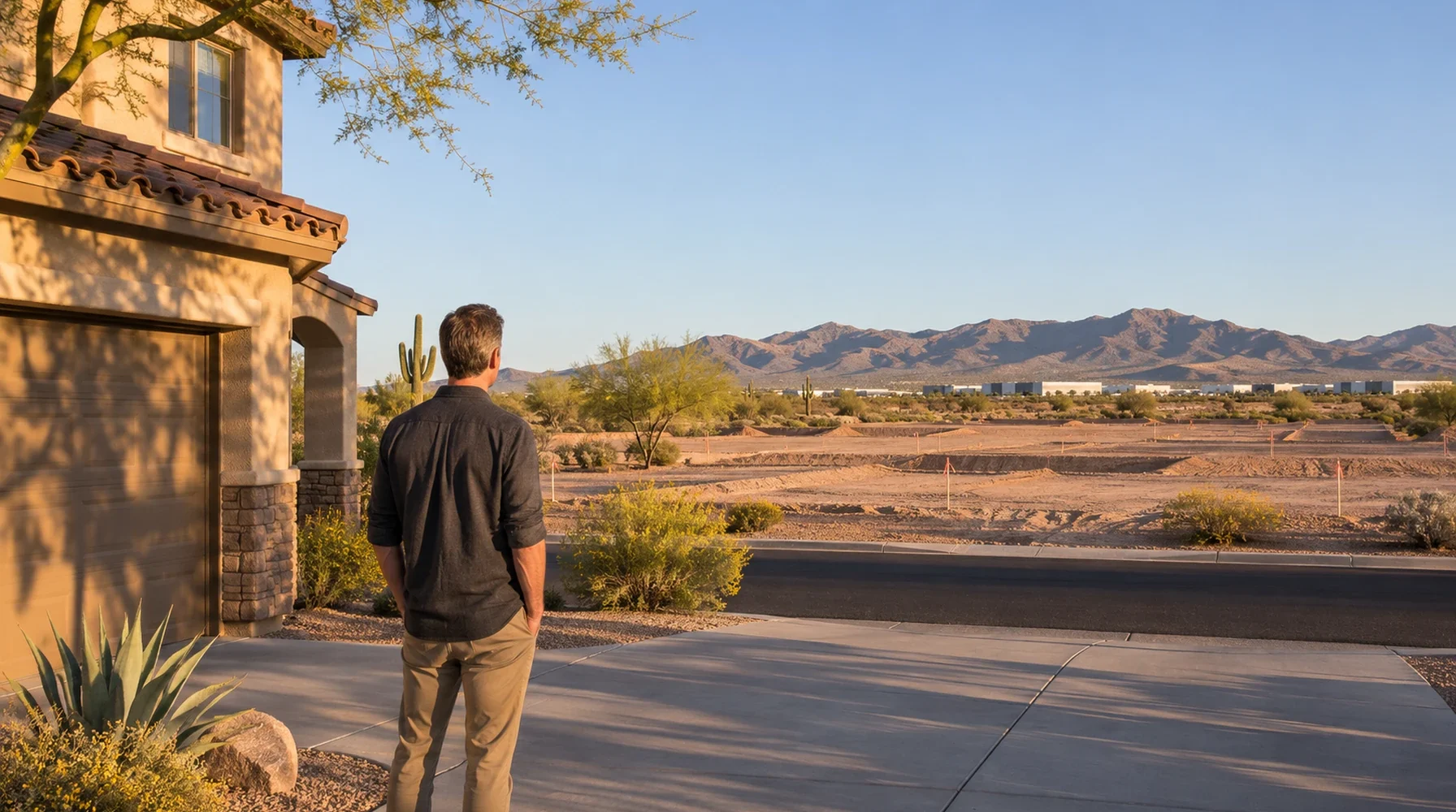
As TSMC suppliers and NorthPark bring more jobs along the Loop 303, should I hold onto my North Phoenix home near Norterra a few more years or sell now and relocate to a quieter Peoria neighborhood?
It depends more on whether Norterra still fits your life than on TSMC. Holding can pay off because homes in a growing job corridor tend to gain value over time, but that takes patience, and Norterra prices were roughly flat over the past year. Selling now lets you capture today’s equity and buy your next home in Peoria while Peoria is a buyer’s market.
The case for holding is real. Norterra sits inside the TSMC demand zone, and the next few years of Fab 2 production, Fab 3 construction, Halo Vista buildout and Loop 303 corridor job growth all favor gradual appreciation in this exact area. The case for selling now is also real. the Norterra market has been steady-to-firming, you can capture current equity, and a move to a quieter Peoria neighborhood today locks in your next home before any TSMC-driven price pressure shows up there too.
This isn’t a “right answer” question. It’s a “right answer for you” question, and the variables that decide it are mostly personal rather than market-driven. Let me walk through what’s actually happening with Norterra pricing, what TSMC and NorthPark add to the picture, and how to think about a Peoria relocation as the destination side of the move.
Norterra’s Market Position in Spring 2026
The Norterra area, ZIP code 85085, covers Norterra proper, Union Park at Norterra, Fireside at Norterra, Dynamite Mountain Ranch, Sonoran Commons, Valley Vista and the broader Happy Valley corridor, and it has been one of the more resilient North Phoenix submarkets in 2026. Median sale prices have been running in the low-$600K range with year-over-year appreciation in the low single digits, and days on market in the high sixties to low seventies. That’s slightly slower than the broader Phoenix market because of the larger home size mix and the higher price point, but it’s not a soft market.
The structural demand for Norterra has multiple supports. Proximity to the TSMC campus at I-17 and Loop 303, roughly fifteen minutes from most of Norterra. The Shops at Norterra and Happy Valley Towne Center retail anchors. Strong Deer Valley Unified schools, including Norterra Canyon K-8. Healthcare access via HonorHealth Sonoran Crossing five miles north and Mayo Clinic Phoenix roughly fifteen miles away. And the lifestyle appeal of trail-accessible communities near the Phoenix Sonoran Desert Preserve. The buyer pool is deeper than for many West Valley submarkets because of all those factors stacked together.
This matters for the seller question because it means you’re not facing pressure to sell now to get ahead of falling Norterra prices. Norterra is holding steady, not weakening. The “sell now” case isn’t built on getting out before things get worse; it’s built on capturing today’s value and redeploying it elsewhere. That’s a meaningfully different motivation, and it leads to a different decision framework than a market-driven exit would. The post on how much your West Valley home should list for covers the data-driven pricing framework that applies to a Norterra listing.
What TSMC and NorthPark Actually Add to the Hold Case
TSMC and NorthPark add long-term job and housing growth to the corridor around Norterra, but most of it arrives over years, not months. TSMC’s North Phoenix campus at I-17 and Loop 303 is the foundation of the corridor’s growth story. Total investment now sits in the $165 billion range across six planned fabs. Fab 2 construction completed in April 2026 with tool installation starting in Q3 2026 and high-volume production targeted for the second half of 2027. Fab 3 is under construction with production targeted for late this decade. A fab is a chip factory, and each one that ramps into production brings additional engineering and operational headcount, much of which looks for housing within commuting distance, a zone that directly includes Norterra.
Halo Vista is the 2,300-acre, roughly $7 billion mixed-use development immediately next to the TSMC campus. Its developers celebrated the start of construction in March 2026, with the first phase focused on roads, utilities and site preparation, according to the Greater Phoenix Economic Council. The plan includes industrial, office, retail, residential and educational uses, which over time creates a more complete live-work-shop area next to the Norterra corridor. TSMC supplier campuses along Loop 303 add their own headcount on top of the TSMC core, expanding the corridor’s job base beyond chip-making itself.
NorthPark is a separate master plan of more than 6,300 acres at the southwest corner of I-17 and Loop 303, led by PulteGroup and TSMC, with land for more TSMC fabs, commercial and industrial space, and single-family homes, according to Construction Reporter. The City of Phoenix approved its rezoning in December 2025, it is planned for roughly 15,000 homes, and construction is not expected to start until 2027. For a Norterra owner, NorthPark cuts both ways: more jobs nearby over time, and more new homes competing for buyers once they are built.
What this adds up to for a Norterra seller: the next three to five years of demand growth in this exact area are well-supported. The real question is how much of that demand turns into price growth for your specific home, and the honest answer is “probably some, but not the kind of jumps seen between 2020 and 2022.” That growth is not showing up in Norterra prices yet, which were flat over the past year. When you own in an expansion area, home values do increase over time, but you have to be patient. Owners who bought early get the benefit of that increase over time, not on a fixed schedule.
No one can tell you what rate Norterra will appreciate at, and ZIP 85085 prices were roughly flat over the past year. What holds in an expansion area is the pattern, not a number: home values increase over time, and the owners who are patient get the benefit of that increase. That makes holding a question of how long you can comfortably stay, not of timing the market. The longer you can hold, the more of that long-term increase you’re positioned to capture, and it has to be weighed against the carrying costs of three more years in the home, the opportunity cost of equity sitting in a single asset, and your own life timeline.
The Costs of Holding That Don’t Show Up in Appreciation Math
Holding a Norterra home for three more years costs real money every month, and those costs come straight out of any appreciation you’re waiting for. Some owners underweight these holding costs in a “should I keep it” analysis. Four recurring costs make up most of the carry on a typical Norterra home:
- Property taxes: Arizona property taxes are relatively modest, but three years of them is still a real number.
- HOA dues: Dues vary by community but are typically meaningful in the master-planned Norterra-area subdivisions.
- Insurance: Homeowners insurance has tightened across Phoenix and is meaningfully higher than it was five years ago.
- Maintenance and repairs: HVAC service, roof inspections, exterior paint cycles, landscape water and pool care all add up over a three-year hold in the desert.
There’s also the opportunity cost question. Opportunity cost is what your money could be doing somewhere else. The equity sitting in your Norterra home is concentrated in a single asset in a single neighborhood. If you sell now and redeploy part of that equity into a more diversified position, or simply into a smaller, less expensive Peoria home with lower carrying costs, you’ve changed your overall financial picture in ways that don’t show up in a pure home-versus-home appreciation comparison.
What I watch for here is the seller who’s holding because “TSMC is coming” without doing the actual carry math. Three years of property tax, HOA, insurance, maintenance and the opportunity cost of equity sitting in one asset can add up to a number that quietly eats most or all of the appreciation you’re expecting. Make the actual comparison: add up what each year of holding costs you, and weigh it against how long you can realistically stay. In an expansion area, patience is what turns the long-term increase in value into a real gain, so the owners who can comfortably hold the longest are the ones most likely to come out ahead.
That doesn’t mean don’t hold. It means hold for the right reasons, with eyes open on the actual net economics, not just the appreciation forecast.
What a Peoria Relocation Actually Looks Like
A Peoria relocation can give a Norterra seller a quieter, lower-density lifestyle, but which part of Peoria you choose matters more than the move itself. Peoria has several distinct profiles: Westwing Mountain and northern Peoria for the larger-lot, lower-density character; Fletcher Heights for the more established neighborhood feel; central Peoria for the urban-suburban mix with access to the P83 entertainment district; and the Vistancia and Northpointe areas for master-planned community living with TSMC-corridor access intact.
A quieter Peoria pocket can mean a meaningfully different lifestyle than Norterra. Lower density, more mature trees in the established neighborhoods, often a smaller home with lower carrying costs, and typically a more relaxed pace. For a seller who’s outgrown the social density of the Happy Valley corridor or is looking for a step-back lifestyle, that’s a real lifestyle value, not just a financial trade. But “quieter” also means different commute patterns, different amenity proximity and a different community character. The version of Peoria that fits a Norterra seller depends a lot on what you’re moving toward, not just what you’re moving away from.
The relocation logistics also matter. A move from Norterra to Peoria is short on the map but can be more complex in practice because you’re managing a sale and a purchase at the same time in two areas with different pricing dynamics. The post on how to coordinate selling and buying at the same time (the Peoria framing applies directly) and the guide on when to sell before relocating to Peoria both walk through the practical sequencing. The Peoria buyer market itself is covered in is now a good time to buy in Peoria.
– Kathy T, Peoria, AZ
The Lifestyle Variable That Drives Most of the Decision
Whether Norterra still fits your life is the variable that doesn’t show up in any spreadsheet, and it tends to drive the actual answer. If Norterra still fits your life (the schools work, the commute works, the social density works, the home itself works), then holding for three more years to capture the corridor’s long-term growth is a defensible choice. If Norterra has stopped fitting your life (the kids have aged out of the school district, the Happy Valley corridor pace has gotten denser than you want, you’d prefer a quieter setting), then no amount of TSMC-driven appreciation justifies staying in a house that’s no longer right.
What I watch for here is the seller who’s holding for financial reasons in a home that’s not fitting their life anymore. That’s an expensive choice. The carry cost over three years includes everything tangible plus the much harder-to-measure cost of living in a house that’s stopped fitting. I also watch for the opposite: the seller who’s selling for lifestyle reasons but framing it as a financial decision. That’s also an expensive choice in a different way, because the lifestyle reason is the real driver and the financial framing is just rationalization.
Be honest with yourself about why the question is even on the table. If the answer is “I’m not sure Norterra still fits,” that’s a lifestyle answer and the appreciation forecast doesn’t change it. If the answer is “Norterra still fits but I’m wondering if I can do better financially by moving,” that’s a financial answer and the carry math should drive it.
Frequently Asked Questions About Selling or Holding a Norterra Home
What’s the current median sale price in the Norterra area?
Recent data places the Norterra submarket (ZIP 85085) median sale price in the low-$600K range, with year-over-year appreciation in the low single digits and days on market in the high sixties to low seventies.
How close is Norterra to the TSMC campus?
Norterra is roughly fifteen minutes from the TSMC campus at I-17 and Loop 303 via I-17, depending on which Norterra-area community you live in.
What’s driving the demand growth in the Norterra area?
The TSMC campus and its $165 billion six-fab buildout, the 2,300-acre Halo Vista development next to it, the NorthPark master plan, the Shops at Norterra and Happy Valley Towne Center, Deer Valley Unified schools, and nearby HonorHealth and Mayo Clinic.
Will Norterra prices keep rising as TSMC ramps up?
No one can promise a rate, and ZIP 85085 prices were roughly flat over the past year. In an expansion area, home values do increase over time, but you have to be patient, so plan around years rather than months.
Is the carry cost of holding three more years material?
Yes. Property taxes, HOA dues, insurance, maintenance and the opportunity cost of concentrated equity all add up. Run the actual numbers before assuming the appreciation lift is free.
What does a quieter Peoria neighborhood actually mean for a Norterra seller?
Depending on the area, it can mean lower density, more mature landscaping, lower carrying costs and a different community character. Westwing Mountain, Fletcher Heights and Vistancia each offer a different version of quieter.
What is NorthPark in North Phoenix?
NorthPark is a master plan of more than 6,300 acres at I-17 and Loop 303, led by PulteGroup and TSMC, with land for more TSMC fabs, commercial space and about 15,000 homes. Phoenix approved its rezoning in December 2025.
The Bottom Line
If Norterra still fits your life and the carry costs are comfortable, holding a few more years to capture the corridor’s long-term growth is a defensible choice, as long as you are patient and don’t count on a specific appreciation rate. If Norterra has stopped fitting your life, the appreciation forecast isn’t a reason to stay. And if you’re considering a Peoria relocation, the quality of that destination decision matters at least as much as the timing of the Norterra sale.
What I tell sellers in this exact decision: don’t frame this as a market-timing question, because Norterra isn’t softening and Peoria isn’t getting dramatically cheaper. Frame it as a life-fit question. The “what do you actually want the next three to five years to look like” question almost always points more clearly than the appreciation modeling does. Make the decision on the life answer first, then let the financial framework support whichever direction that points. That’s how you make your move with clarity and confidence, and it’s the clear, personalized guidance I bring to every seller, built around today’s market and your unique situation.
If you want to talk through how holding or selling affects your specific Norterra home and a possible move to Peoria, let’s explore your options. You can reach me, Kasandra Chavez with the Chavez Dream Home Team, at 928-910-7401, or grab a time on my calendar.