


How Prasada Retail and Mixed-Use Growth Is Affecting Surprise AZ Home Values
How are new Prasada retail and mixed-use projects along Waddell and Cotton impacting home values in nearby Surprise neighborhoods?
Homes within a short drive of Prasada are seeing steadier demand and longer-term value support than the broader Surprise market, but the lift is not uniform and it is not immediate. Newer phases like the 16-acre development at Cactus and Cotton Lane and the upcoming Prasada East at Sarival and Waddell are still leasing tenants and working toward construction, so the visible amenity premium gets stronger as each phase opens, not the moment the press release drops.
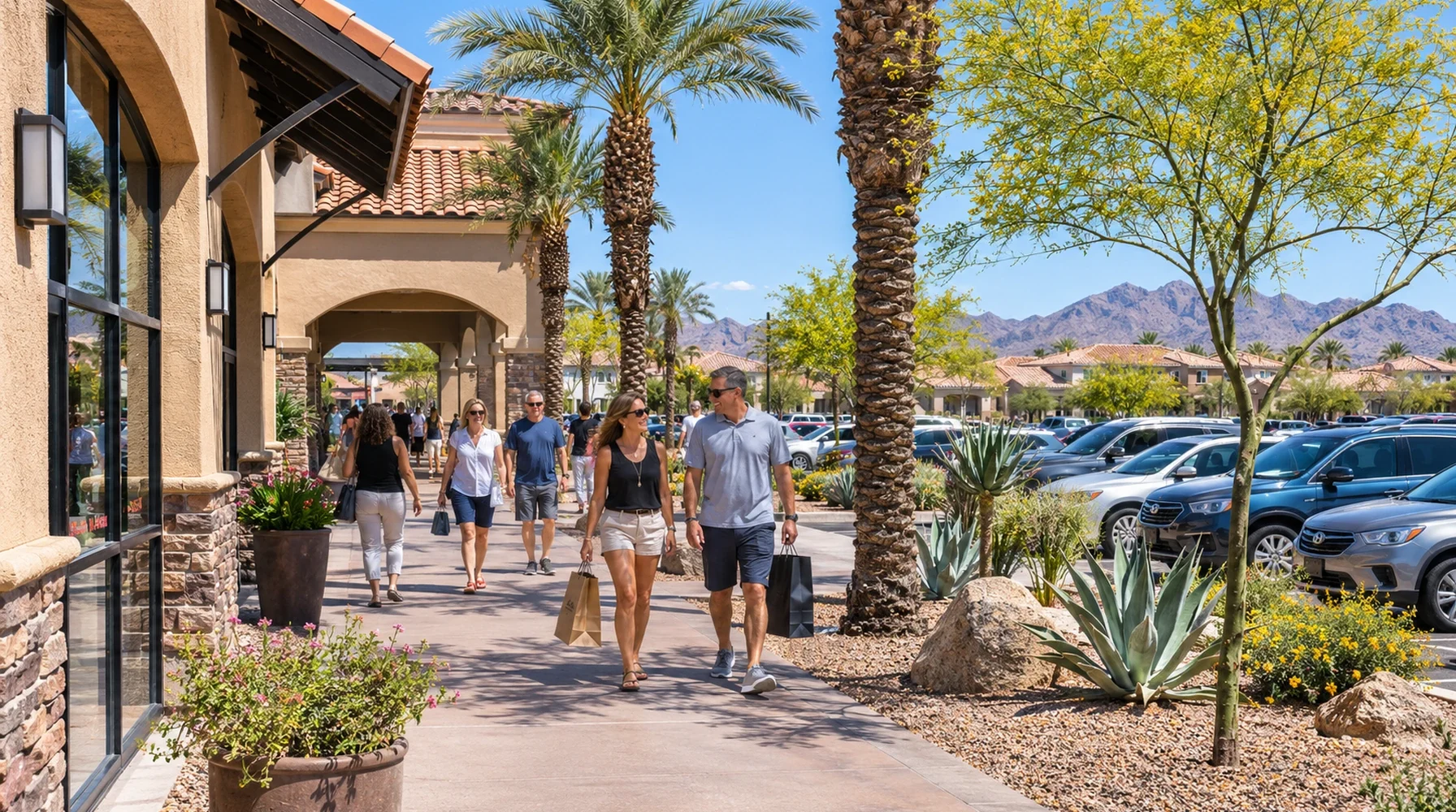
The Loop 303 corridor has been transforming for years, but Prasada is what many buyers and sellers in Surprise actually feel. Costco, Target, restaurants, a planned Whole Foods, a hotel: these are the day-to-day reasons people are willing to drive past older Surprise neighborhoods to look at homes here. Here’s what I see when I tour the area with clients: the conversation has shifted from “Is there anything to do out here?” to “Which subdivision puts me closest to it?” That shift matters when you’re weighing whether to buy, sell, or wait.
What Prasada actually is right now versus what is still on paper
Prasada in Surprise is part open and operating, part still on paper. Village at Prasada, the open-air power center at Loop 303 and Waddell, is operational and largely occupied, anchoring the corridor with grocery, big-box retail and dining. Prasada North is adding several hundred thousand square feet across the street, opening in phases. The newer 16-acre mixed-use project at the northeast corner of Cactus Road and Cotton Lane is in development, designed for retail, service, hospitality and entertainment uses.
Prasada East at Sarival and Waddell, announced in early 2026, will add a premium grocer and additional restaurants in a separate node a few minutes east. For you, that means the Whole Foods is a real, planned project, but it is not a store you can shop at yet.
For a home shopper, this means the “Prasada effect” is layered. A house within a five- to ten-minute drive of Village at Prasada is benefiting from amenities that already exist. A house closer to Cactus and Cotton or Sarival and Waddell is buying into amenities that are coming but not yet open. Both can be smart purchases. They’re just different bets with different timelines, and the price you should be willing to pay reflects that.
Why proximity to retail and mixed-use moves home values
Proximity to retail and mixed-use moves home values in Surprise because buyers pay a premium for convenience, and the premium gets larger as the amenity becomes harder to replace elsewhere. A neighborhood that puts a buyer 7 minutes from a major grocery anchor, a coffee shop, urgent care and a sit-down restaurant gets a structural advantage over one that puts them 20 minutes from all of it. That advantage shows up in three ways: shorter time on market when listings are priced correctly, fewer price reductions during the marketing period, and a sale price that lands closer to the original list price.
What I watch for here is the gap between sale price and original list price in subdivisions adjacent to Prasada compared to subdivisions farther from it. The original list price matters because it shows where a seller started, before any reductions. When inventory loosens, and Surprise inventory has been loosening, the convenience premium becomes more visible, not less, because buyers feel free to be choosier about location.
What the broader Surprise market is doing in 2026
Setting Prasada aside for a moment, the wider Surprise market is in a softer, more balanced posture than it was two years ago. Median sale prices have eased modestly year-over-year, days on market have stretched out into the balanced-to-buyer-favored range depending on the source, and the sale-to-list ratio has settled below 100%. That’s not a crash. It’s a reset, and it gives buyers more negotiating room than they’ve had in years.
This matters for the Prasada question in a specific way: in a softer overall market, the location premium that anchors near Prasada bring becomes a defensive feature for sellers, not just an offensive one. Sellers in stronger micro-locations hold their pricing better. Sellers in weaker micro-locations have to accept more concessions, longer listing periods, or both. If you own near Prasada and you’re considering selling, the corridor’s momentum is working with you, but it doesn’t make pricing irrelevant. If you own farther out, the corridor’s growth doesn’t protect your home from broader pricing pressure.
What this means if you’re buying near Prasada in 2026
If you’re buying near Prasada in Surprise, you usually have more time than it feels like. The instinct I see most often is rushing to lock in a home before “the next phase opens.” That instinct is usually wrong. The phases roll out over years, not weeks, and Surprise’s current inventory environment gives a careful buyer time. At this stage, I help buyers narrow their focus to three questions: How close is the home to currently operational amenities versus planned ones? What’s the actual drive time to Loop 303 and to the school district boundary that matters for resale? And what does the price per square foot look like compared to similar homes a mile or two away from the Prasada nodes?
The third question is the one that surfaces real value. Asking prices on homes inside the immediate Prasada draw zone sometimes assume the future amenity premium is already priced in. That’s not always accurate, and a buyer can sometimes find better total value a few minutes farther out, especially in a market where they have time to negotiate. Our look at how Prasada East could change neighborhood desirability in Surprise walks through which pockets sit closest to the new phase. For comparison shoppers weighing a Surprise home against a Buckeye master-planned alternative, PebbleCreek and Sun City West are useful benchmarks for how amenity-rich West Valley communities tend to hold value over time.
One more variable that moves resale: distance from Loop 303 itself. Homes immediately backing the freeway tend to face buyer hesitation regardless of corridor amenities, while homes positioned a few streets in capture the access benefit without the noise penalty. The city’s Development Areas overview is useful reading if you want to understand which corridors are slated for further commercial intensification and which are residential-protected. That information affects long-term resale far more than next quarter’s tenant announcements.
What this means if you’re selling near Prasada in 2026
If you’re selling near Prasada in Surprise, the corridor’s growth is real, but it doesn’t price your home for you. With overall Surprise days on market lengthening and price reductions more common across the market, sellers near Prasada still need to lead with sharp pricing, not with optimism about future amenities. The mistake I see is anchoring the list price to what a similar home sold for during the 2022 surge, or to the perceived value of the new Whole Foods opening months from now. Today’s buyer is comparing your home to actual closed sales, or comps, from the last 60 to 90 days, not to a press release.
This is usually where I slow sellers down. The strongest play in a softening market with a strengthening micro-location is to price competitively, market the proximity advantage clearly in the listing copy and showings, and let the corridor story do its work as a tiebreaker, not as a justification for a price the comps don’t yet support. Our guide to pricing and marketing a Surprise home as Prasada East and Whole Foods take shape covers the listing side in more detail. For long-term Surprise owners thinking about their first sale in over a decade, the contract deadlines and procedural steps in an Arizona sale deserve attention well before you commit to a list date. The AAR contract is deadline-driven, and a missed response window can cost real money.
– Julie S, Goodyear, AZ
Frequently Asked Questions About Prasada and Surprise Home Values
How close to Village at Prasada do I need to live to benefit from the amenities?
Most buyers feel the convenience benefit at roughly a five- to ten-minute drive. Beyond that, the practical difference between a Surprise neighborhood near Prasada and one elsewhere in the city tends to fade.
What is Prasada East?
Prasada East is a planned 98,000-square-foot open-air center by SimonCRE on about 10 acres next to Village at Prasada in Surprise. It is anchored by a Whole Foods Market, with Barnes & Noble and Flower Child among its signed tenants.
When will the Whole Foods in Surprise open?
The Whole Foods is planned as part of Prasada East, announced in early 2026. Treat it as a future amenity, not a current one, until it opens.
Is the planned Prasada East opening already priced into nearby homes?
Sometimes yes, sometimes no. Asking prices on individual listings can run ahead of comparable closed sales, which is why pricing against actual recent comps, not against announcements, matters more than ever right now.
Are Loop 303 noise and traffic a real concern for resale value?
For homes directly backing the freeway, yes. For homes a few streets in, the access benefit usually outweighs the drawback at resale.
Are builders offering more incentives near Prasada because of the development activity?
Builder incentives in the West Valley have been more generous through 2026 than during the 2022 surge. Specific incentive packages change frequently, so confirm them directly with each builder rather than from broad statements online.
Will a home near Prasada hold value better in a soft market?
On average, homes in stronger micro-locations hold pricing better when broader inventory loosens, because buyers gain the freedom to be choosier. That’s an average; your specific home’s pricing, condition and presentation still drive the outcome.
The bottom line
Prasada is genuinely changing what Surprise feels like, and it’s changing what nearby homes are worth, but the change is gradual, layered and uneven across the corridor. Buyers have more time than they think to evaluate proximity trade-offs against price. Sellers have a real micro-location story to tell, but only if their pricing is grounded in current comps rather than future announcements. The right move depends on which property, which phase of the corridor and which timeline, not on the headline.
Sorting what is open today from what is still on paper, and pricing or buying against real closed sales, is how you make your move with clarity and confidence. That is the work I do with every client, built around today’s market and your unique situation.
If you want to talk through how Prasada’s growth affects your specific Surprise home or search, let’s chat. You can reach me, Kasandra Chavez with the Chavez Dream Home Team, at 928-910-7401, or grab a time on my calendar.