


New Construction vs. Resale in Buckeye, AZ: How to Decide
Is it a good idea to buy new construction in Buckeye, or should I stick with resale?
Both can be excellent choices in Buckeye; the right one depends on your timeline, your flexibility, and how much uncertainty you’re willing to carry through the process. New construction offers customization and a builder warranty, but it comes with contract terms that heavily favor the builder. Resale moves faster and gives you more negotiating leverage, but you’re inheriting someone else’s decisions.
Neither is automatically better. The answer lives in your specific situation.
Why Buckeye Buyers Ask This Question
Buckeye has become one of the fastest-growing cities in the entire country. According to AZ Big Media’s analysis of Arizona’s fastest-growing housing markets, Buckeye’s population grew 81% over the last decade and housing inventory expanded 72%, with home prices nearly tripling in that same period. The development happening along the I-10 corridor and out toward Verrado and Tartesso means buyers here often encounter both options simultaneously. You can drive five minutes in any direction and find a shiny new model home with an on-site sales rep, and a resale listing on the same block.
That creates a real decision point, and it’s one most buyers feel underprepared for. The builder’s sales office is polished, professional, and very good at walking you through upgrades. Resale listings live in the MLS and get negotiated the traditional way. The processes couldn’t be more different, and the stakes are just as high in both directions. If you’re weighing this decision in Buckeye right now, you’re not overthinking it; you’re asking the right question at the right time.
What that means for you is that the comparison is rarely theoretical in Buckeye: both paths are usually close by, so the decision comes down to the process you are signing up for, not just the house. If you are comparing cities as well, our guide to new build vs. resale homes across the West Valley looks at the same choice more broadly.
What New Construction Actually Offers in Buckeye
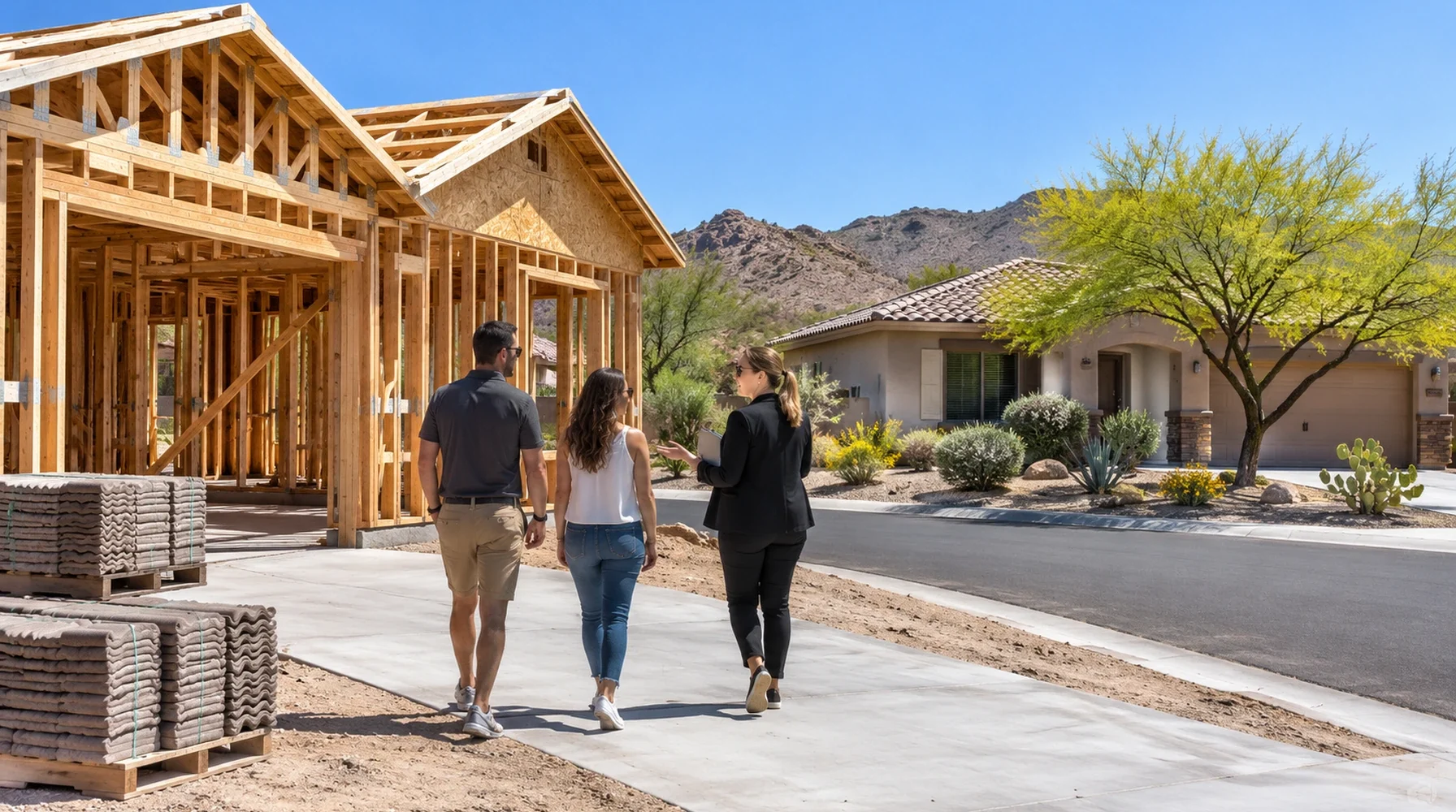
New construction in Buckeye offers a home no one has lived in, a builder warranty and often financing incentives, and in exchange you take on the builder’s contract and the builder’s timeline.
The appeal of new construction is real. You get a home no one has lived in. You may have the opportunity to choose your finishes, your lot, your floor plan. Builder warranties typically cover workmanship and structural elements for a set period after closing. And in a market like Buckeye, where inventory has been building out across several large master-planned communities, there’s genuine variety in what builders are offering.
Builders in this area also frequently offer financing incentives (rate buydowns, closing cost contributions, or upgrade credits) when you use their preferred lender. A rate buydown is money the builder puts toward lowering your mortgage interest rate, either for the first years of the loan or for its full term. Those incentives can be meaningful, and they’re worth understanding clearly before you walk away from them. The NAR consumer guide on buying new construction outlines the full range of new construction options available to buyers, from spec homes to design-phase builds, and is a useful reference for understanding what each path involves before you sit down with a builder. A spec home is one the builder has already started or finished without a specific buyer in mind.
But new construction comes with tradeoffs that aren’t always obvious on a model home tour. The builder’s contract is not the Arizona Association of Realtors (AAR) residential purchase contract your agent uses. It’s written by the builder’s legal team, for the builder’s protection. Timelines can shift. Costs can escalate if you’re in the design center longer than planned. And the on-site sales representative works for the builder, not for you.
This is usually where I slow buyers down and ask them to read the contract before they fall in love with the countertops.
What Resale Offers, and Where It Has the Edge
Resale homes in Buckeye give you something new construction can’t: a known commodity. The home is finished, the landscaping is established, and you can walk through every room before you commit. You know what the neighborhood feels like: the traffic patterns, the noise, the neighbors.
Resale also puts you in a more familiar negotiating position. Under the AAR contract, you have a 10-day inspection period to evaluate the home’s condition. Sellers are required to complete a Seller’s Property Disclosure Statement (SPDS), Arizona’s standard disclosure form, which gives you documented information about the property’s history directly from the seller. If something comes up in the inspection, there’s a defined process for addressing it.
Earnest money in the Phoenix metro typically runs 0.5 to 1% of the purchase price, and closing timelines on resale transactions generally run approximately 30 days from contract to keys. Earnest money is the good-faith deposit you put down when your offer is accepted, and it goes toward your purchase at closing. Those timelines and terms are more predictable and more balanced between buyer and seller than what most new construction contracts offer.
In Buckeye specifically, the resale market can move at varying speeds depending on the neighborhood and price point. For buyers who want to explore more about buying in the West Valley, browse more West Valley market insights to stay current as conditions shift.
– Gloria B, Buckeye, AZ
The New Construction Contract: What You Need to Know Before You Sign
A builder’s contract in Buckeye is the builder’s own form, not the standard AAR contract, so the terms that matter most (inspection access, earnest money and timelines) need to be read before you sign, not after.
This is the section most buyers wish they’d read before sitting down with a builder’s sales rep.
Builder contracts in Arizona are not standardized the way the AAR contract is. Each builder uses their own form, and those forms can include provisions that lock in your purchase price only up to a point, allow for schedule extensions without penalty, and limit your ability to back out without losing your earnest money, which with builders can run significantly higher than the 0.5 to 1% typical in resale transactions.
One of the most common mistakes buyers make in new construction is assuming their inspection rights mirror what they’d have in a resale deal. They don’t. Some builders restrict when and how you can bring in a third-party inspector. Knowing your rights before you need to exercise them is the entire point of having representation. At this stage, I help clients narrow their focus to understanding exactly what the builder’s contract says about inspection access, earnest money forfeiture, and timeline flexibility, before they fall in love with the floor plan.
The builder’s preferred lender incentives deserve the same scrutiny. Builder rate buydowns are often genuinely competitive. But you have the right to get a quote from your own lender for comparison, and a good agent will help you evaluate whether the incentive is worth staying inside the builder’s ecosystem. Our guide to comparing builder contracts, incentives and warranties walks through the same clauses for nearby Goodyear.
HOA Considerations in New Construction vs. Resale Communities
Buckeye is HOA country. Whether you’re buying new or resale, you’re likely buying into a community with an association, and the details matter. An HOA, or homeowners association, sets the community’s rules and collects dues to maintain shared areas. With major master-planned communities like Verrado and the upcoming Teravalis development underway, the Arizona housing market report from AZ Big Media offers useful context on how large-scale development shapes community structure and what buyers can expect as these neighborhoods mature.
In newer master-planned communities, the HOA is often still developer-controlled during the initial build-out phase. That means the rules, dues structure, and budget can shift as the community matures and transitions to homeowner control. Understanding where in that lifecycle a community sits is worth knowing before you sign.
For resale homes in established Buckeye neighborhoods, you’ll want to look at how often HOA dues have increased over the past few years, whether there are any pending special assessments, and when the community’s exterior paint cycle is due. Most communities repaint on a roughly 10-year rotation, but not all. A special assessment is a one-time charge the association bills to owners for a specific project or shortfall, on top of regular dues. If you plan to have an RV, a boat, or a specific outdoor setup, confirming where the HOA stands on that now will save you a difficult conversation later. For a side-by-side example, see how HOA fees in Verrado compare to Tartesso.
Neither new nor resale automatically wins on HOA. What matters is reading the documents and asking the right questions before you’re under contract.
How to Actually Make the Decision
Neither new construction nor resale is the default right answer in Buckeye. The right answer depends on four things: your timeline, your tolerance for uncertainty, your priorities in a home, and your financial picture.
If you need to be in a home within 30 to 60 days, resale is almost always the more reliable path. Builder timelines can slip, and even a home described as “move-in ready” may have a delivery window that shifts. If you have flexibility, if you can wait six months or more, new construction opens up considerably. If a build is on the table, our look at how long it takes to build a new home in Buckeye can help you set that timeline.
If you want specific finishes and don’t want to inherit someone else’s choices, new construction can be worth the tradeoff. If you want an established yard, a known neighborhood feel, and a more predictable transaction process, resale usually wins.
On the financial side: builder incentives can genuinely lower your monthly payment in ways that matter. But you’ll want to model the numbers with and without those incentives, using your own lender as a baseline, so you’re comparing on equal footing. What I watch for here is whether a buyer is being guided by the incentive rather than by what actually makes sense for their goals. The NAR’s consumer guide on preparing for homeownership is a useful checklist for buyers at this stage, covering the financial preparation steps that apply regardless of whether you’re going new construction or resale.
Frequently Asked Questions About New Construction vs. Resale in Buckeye
Do I need my own agent to buy new construction in Buckeye?
Yes, and it costs you nothing. The builder pays the buyer’s agent commission in most transactions. Having your own agent means someone is reviewing that contract on your behalf and advocating for you at every stage, including the final walkthrough.
Can I negotiate with a builder in Buckeye?
Builders typically hold firm on base price, but they often have flexibility on incentives: upgrades, closing cost contributions, rate buydowns, or lot premiums. The terms and what’s available shift depending on the builder’s sales pace and where you are in a phase.
What does the inspection process look like for new construction in Arizona?
Even new construction should have an independent inspection. In Arizona, your right to bring in a third-party inspector should be clearly addressed in your contract; know what it says before you’re under contract, not after.
What’s the typical earnest money on a resale home in Buckeye?
In the Phoenix metro, earnest money typically runs 0.5 to 1% of the purchase price, though it can vary based on market conditions and offer strength. Builder contracts often require higher earnest money amounts, and refund terms are different. Read those terms carefully.
How long does closing take on a resale home in Buckeye?
Most resale transactions in Buckeye close in approximately 30 days. New construction timelines vary significantly depending on where the home is in the build process and the builder’s schedule.
Who does the on-site sales rep at a Buckeye model home work for?
The on-site sales representative works for the builder, not for you. The builder’s contract is also written by the builder’s legal team for the builder’s protection, which is why having your own representation matters.
How long is the inspection period on a resale home in Buckeye?
Under the Arizona Association of Realtors (AAR) contract, you have a 10-day inspection period to evaluate the home’s condition. The seller also completes a Seller’s Property Disclosure Statement (SPDS), Arizona’s standard disclosure form.
Do new construction and resale homes in Buckeye have HOAs?
Usually, yes. Buckeye is HOA country, so new or resale, you are likely buying into a community with an association. In newer master-planned communities, the HOA is often still developer-controlled, so rules and dues can shift.
Should I use the builder’s preferred lender in Buckeye?
Builder rate buydowns are often genuinely competitive, but you can get a quote from your own lender for comparison. Model the numbers with and without the incentive so you are comparing on equal footing.
What to Take Away From This
The new construction vs. resale decision in Buckeye isn’t about which option is universally better. It’s about which one fits your situation, and whether you’re going in with clear eyes about what each one actually involves.
New construction gives you something fresh and customized, but it asks you to navigate a builder’s process with a builder’s contract. Resale gives you a known product with more familiar transaction terms, but it requires you to evaluate what you’re inheriting. In both cases, the details in the contract (the inspection rights, the earnest money terms, the timeline commitments) are where the real decision lives.
You don’t have to figure that out alone. Buckeye is a market worth understanding before you commit either way.
Reading the contract before you fall in love with the floor plan, and weighing it against your own timeline and numbers, is how you make your move with clarity and confidence, and it is the part of the process I walk through with every buyer weighing a builder against a resale.
If you want to talk through whether new construction or resale fits your timeline and budget in Buckeye, let’s chat. You can reach me, Kasandra Chavez with the Chavez Dream Home Team, at 928-910-7401, or grab a time on my calendar.