


Do Litchfield Park Design Rules Slow Down a Home Sale?
How do Litchfield Park’s strict aesthetic guidelines affect days on market?
The guidelines themselves rarely slow a sale. What slows a Litchfield Park sale is unapproved exterior work discovered after you are already under contract, such as a patio cover, a paint color, a driveway extension, or a garage conversion that never went through the city’s Design Review Board or the HOA. The guidelines are a known, visible feature of the city that buyers accept, while an open compliance problem in the middle of escrow is a surprise, and surprises are what cost you time.
Sellers here often frame this as a marketing worry: does Litchfield Park’s reputation for design control scare buyers off? In my experience it does the opposite. Buyers who choose Litchfield Park are frequently choosing it because of the consistency the rules produce. The risk sits somewhere less obvious. Litchfield Park is one of the few West Valley cities where the municipality itself reviews the exterior of your home, on top of whatever your HOA enforces, and most homeowners do not realize both layers exist until something they built years ago becomes a problem at the worst possible moment. This is usually where I slow sellers down, well before we talk about price.
What Litchfield Park’s Design Rules Actually Require
Litchfield Park operates a city-level Design Review Board, which is unusual in the West Valley. Under the city’s process, a property owner must apply for and receive Design Review Board approval before the development, construction, remodel, or substantial alteration of the exterior of any existing or proposed project. The board meets on a scheduled basis rather than continuously, so any approval you need runs on the board’s calendar, not yours.
This is separate from your HOA. The city’s own guidance is explicit that while the Design Review Board regulates alterations to a building’s exterior, CC&Rs (the recorded covenants, conditions and restrictions that set a neighborhood’s rules) are enforced by your homeowners association rather than by the city. So a Litchfield Park homeowner can be subject to two independent approval layers for the same project, and clearing one does not clear the other.
Practically, that means exterior paint colors, roof material changes, patio covers, ramadas, garage or carport conversions, and other visible modifications may require approval you did not know to get. The city maintains a color palette, and alternatives generally require specific approval. For a seller, the question to answer is not only whether the HOA signed off on a change, but whether the city did too.
Why Unapproved Work, Not the Guidelines, Delays Closings
An unapproved exterior modification delays a Litchfield Park closing because it turns into a title, disclosure, and repair-negotiation problem all at once, usually inside the ten-day inspection period under the AAR contract, the standard Arizona Association of REALTORS® purchase contract.
Here is the sequence I see. A buyer’s inspector notes a patio cover or a converted space. The buyer’s agent asks whether it was permitted. The seller does not know. Now, mid-inspection-period, everyone is calling the city and the HOA to reconstruct history on a project completed years ago. Even when the answer turns out to be fine, the days spent finding out are days the contract is exposed. If the answer is not fine, the buyer is asking for a credit, a retroactive approval, or a cancellation.
None of that is caused by Litchfield Park having design standards. It is caused by the standards being discovered late. A seller who documents approvals before listing removes the whole sequence.
What I watch for on a Litchfield Park pre-listing walk-through is anything visible from the street or the yard that postdates the original construction. If I cannot tell when it was added, we find out before a buyer’s inspector does.
– Ankita C, Gilbert, AZ
What to Check Before You List in Litchfield Park
Before listing in Litchfield Park, inventory every exterior change made to the property since it was built and confirm each one was approved by whichever body had jurisdiction over it. Do this while you still have time to fix problems, not while a buyer’s inspector is generating a report.
Five items account for most of the compliance surprises I encounter on Litchfield Park listings:
- Exterior paint color: Confirm the current color was approved, since alternatives outside the city’s palette generally require specific approval and HOAs often maintain their own approved color list.
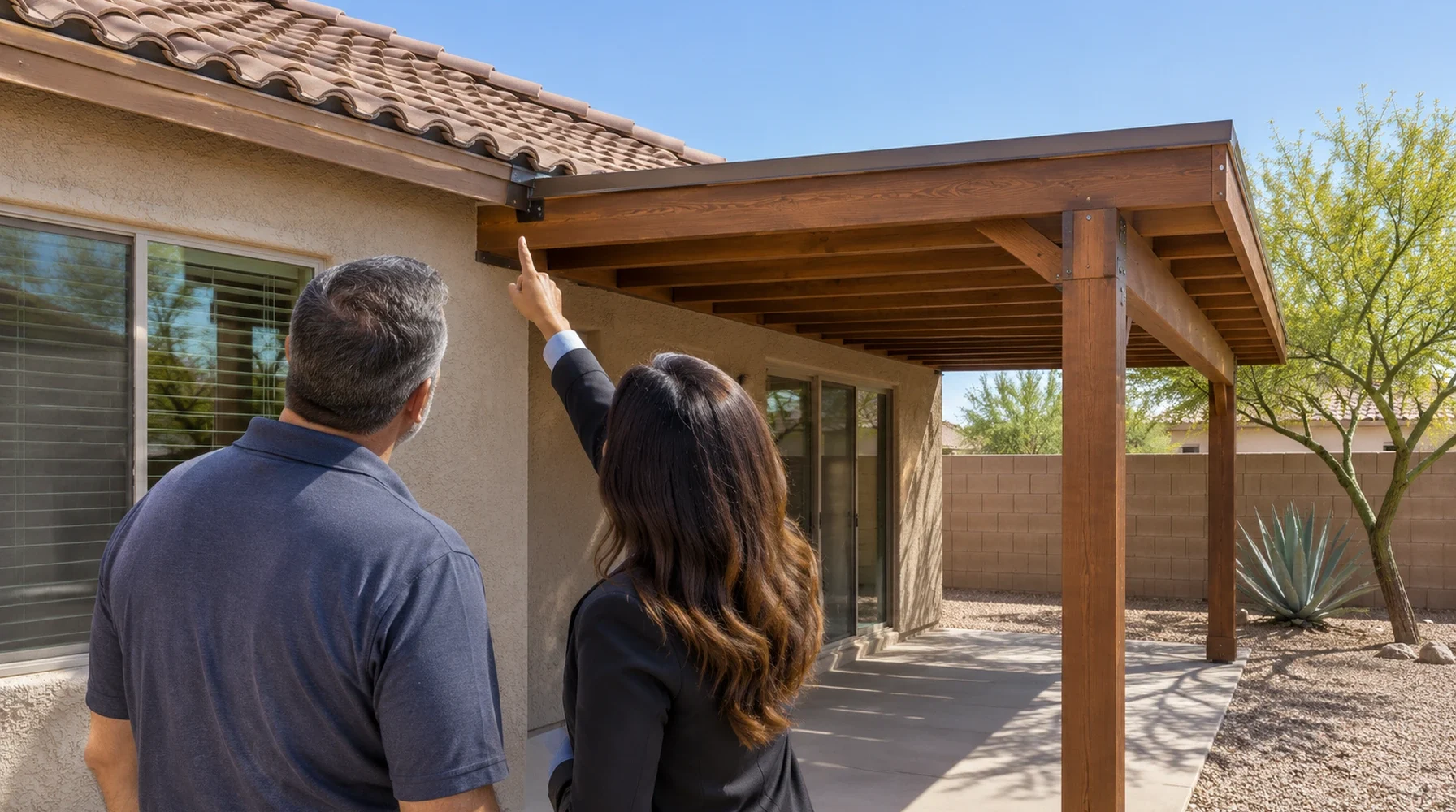
- Patio covers and ramadas: Attached and detached shade structures are visible exterior alterations and commonly get built without either city or HOA approval.
- Garage or carport conversions: Converting a carport or garage into living space changes the street-facing elevation and typically requires design review before a permit is even submitted.
- Landscaping changes: Some Litchfield Park HOAs require architectural approval for landscaping, including front-yard changes many owners assume are unregulated.
- Roof material changes: A reroof using different material than the original can require approval even when a like-for-like replacement would not.
Two of those, paint and landscaping, surprise sellers most, because they feel like maintenance rather than alteration. If you inherited the home’s current condition from a previous owner, you inherited the compliance question with it.
This approval check sits alongside the usual prep list in what to fix before listing a West Valley home. A pre-listing inspection can also surface some of the same items early, though an inspector reports on condition, not on whether the city or the HOA ever approved the work.
How Compliance Actually Shows Up in Your Sale
Compliance shows up in a Litchfield Park sale through your disclosures and through the buyer’s inspection, and both are manageable if you handle them early. Arizona sellers complete the SPDS (Seller Property Disclosure Statement, the form where you tell a buyer what you know about the home), which asks about the property and its condition, including improvements and any known issues. Documented, approved work is a clean disclosure. Undocumented work is not.
The good news is that this is a solvable problem when you start early. Retroactive approval is often possible; it just takes time that you do not have once a contract is signed. Pulling your approval records, checking with the city and your HOA, and resolving open items before listing converts a potential deal-threat into a non-event.
If your Litchfield Park home is in an HOA, the association’s own document delivery and transfer process is a separate timing factor sitting alongside this one, and it lands in the same escrow window. The mechanics are similar to what I describe in how HOA architectural review and transfer steps can delay a closing, and the paperwork side is covered in what Arizona’s HOA disclosure rules mean for West Valley sellers.
Frequently Asked Questions About Litchfield Park Design Review and Selling
Does Litchfield Park require city approval for exterior changes?
Yes. Litchfield Park’s Design Review Board must approve development, construction, remodels, and substantial exterior alterations before the work proceeds. This is a city requirement separate from any HOA rules.
Is the Litchfield Park Design Review Board the same as my HOA?
No. The city’s Design Review Board regulates the building exterior, while CC&Rs are enforced by your homeowners association, not the city. A Litchfield Park property can be subject to both.
Do Litchfield Park’s design rules scare buyers away?
Rarely. The guidelines are a known, visible feature of the city, and buyers who choose Litchfield Park are frequently choosing it because of the consistency the rules produce.
What happens if I sell with unapproved exterior work?
It typically surfaces during the buyer’s inspection period and becomes a disclosure and negotiation issue. Retroactive approval is often possible but takes time you may not have once you are under contract.
How long is the inspection period when selling a home in Arizona?
Under the AAR purchase contract, the buyer’s inspection period is ten days. Any question about unapproved exterior work usually has to be answered inside that window.
Which exterior changes most often need approval in Litchfield Park?
Exterior paint colors, patio covers and ramadas, garage or carport conversions, landscaping changes, and roof material changes account for most of the compliance surprises on Litchfield Park listings.
Do I have to disclose unpermitted work in Arizona?
Arizona sellers complete the SPDS, which asks about the property’s condition and improvements. Known unpermitted or unapproved work belongs on the form rather than left for a buyer to discover.
Should I fix compliance issues before listing in Litchfield Park?
Generally yes. Resolving approvals before listing removes a common cause of mid-escrow delay, and it is far easier to handle on your own timeline than under contract deadlines.
The Bottom Line for Litchfield Park Sellers
Litchfield Park’s design standards are not a liability on your listing. They are part of why the city looks the way it does, and buyers who shop here generally want that. Treating the guidelines as a marketing problem misdiagnoses the risk.
The real risk is documentation. Two approval layers, the city’s Design Review Board and your HOA, govern the exterior of your home, and any work that skipped either one is sitting on your property waiting to be found. Inventory it, document it, and resolve what needs resolving before you list. Sellers who do that move through escrow without the mid-contract scramble, and that is where the time savings actually come from.
Knowing what your home’s exterior history looks like before a buyer asks is how you make your move with clarity and confidence. That is why, with Litchfield Park sellers, I walk the property before it lists and flag anything worth documenting first, well before we set a price.
If you want to talk through how Litchfield Park’s design review and HOA approvals affect your specific home, let’s chat. You can reach me, Kasandra Chavez with the Chavez Dream Home Team, at 928-910-7401, or grab a time on my calendar.