


Will Industrial Growth Near SR 85 Hurt My Buckeye Home Value?
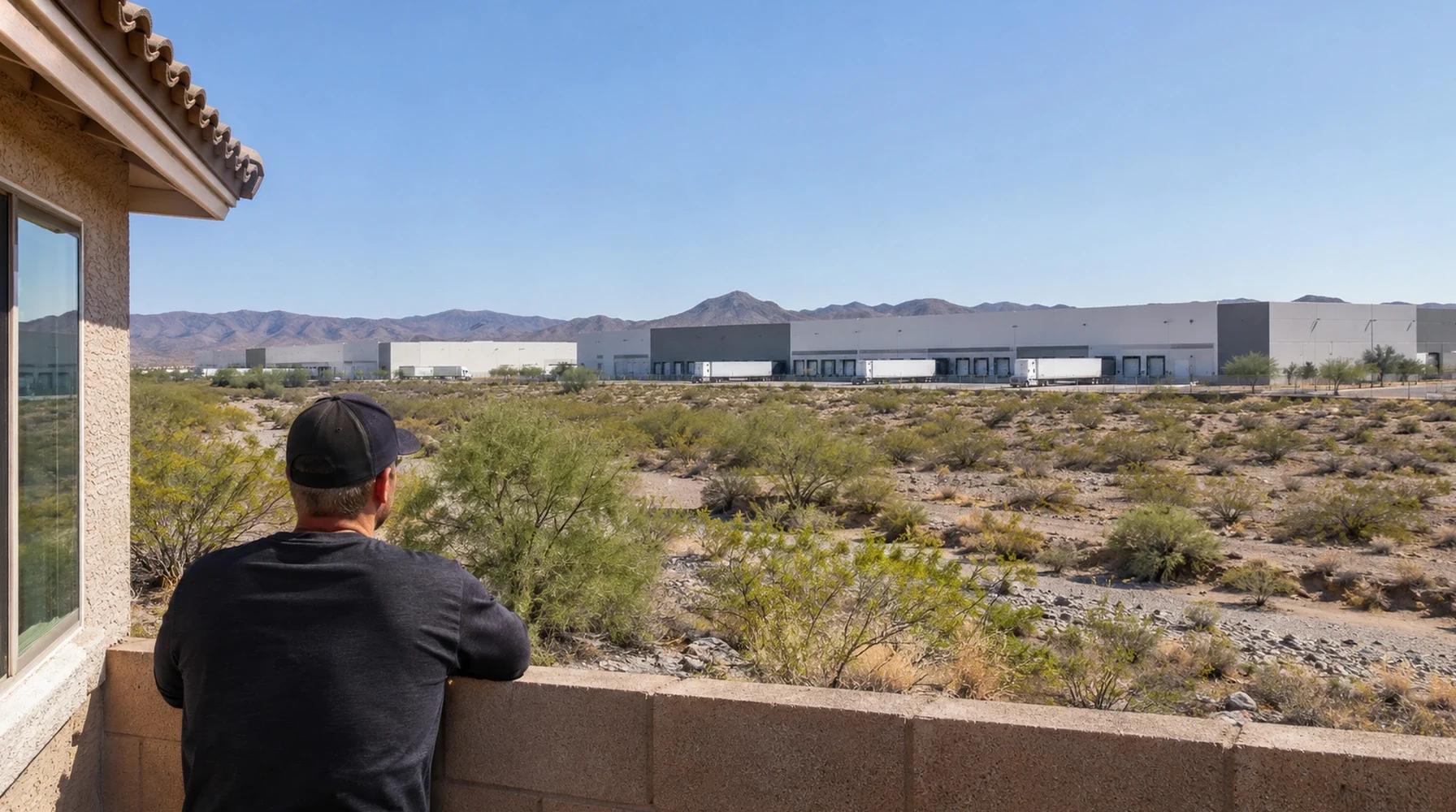
Walmart just bought land for distribution near SR 85 and Southern in Buckeye: will growing industrial and logistics development near my neighborhood hurt my home’s resale value?
Probably less than you think, and the first thing worth knowing is that Walmart already operates a distribution center on Southern Avenue in Buckeye. This is expansion of an existing footprint, not a new arrival, and there’s a track record in that corridor to look at. What actually drives the impact on your home is distance and orientation: whether you’re adjacent to truck routes and loading operations, or simply in the same city as them.
Industrial news lands harder than almost any other development announcement. A retail center reads as an amenity; a distribution corridor reads as trucks, noise, and something happening to your neighborhood rather than for it.
That reaction is understandable and incomplete. Industrial development affects nearby homes through mechanisms that pull in opposite directions, and the net result depends on specifics a headline can’t tell you. What I watch for here is a seller making a timing decision off a news article instead of off their actual location.
What Walmart Actually Bought Near SR 85 and Southern in Buckeye
Walmart acquired roughly 38 acres at the northeast corner of State Route 85 and Southern Avenue in Buckeye, in a deal that closed at the end of July 2026. The seller had rezoned the property as a planned area development for a future light industrial park called AZ85, a project totaling around 144 acres including adjacent parcels. Reporting indicates Walmart’s Buckeye acquisitions across two deals total closer to 80 acres.
A planned area development is a zoning approval written around one specific project, so it tells you the intended use of the land well before anything is built. For a Buckeye homeowner, that intended use is the part to pay attention to.
Two qualifiers matter. First, this is a land purchase, not a construction announcement: no publicly confirmed building, timeline, employment figure, or facility type is attached to it yet. Second, the zoning is light industrial, a different category from heavy manufacturing in noise, emissions, and operating intensity.
This stretch of Buckeye near SR 85 has been an industrial and distribution corridor for years, with several warehousing projects planned or underway, and Walmart’s existing Buckeye distribution center sits on Southern Avenue. A homeowner here is not watching an industrial corridor arrive; they’re watching an established one fill in.
Does Industrial Development Near a Buckeye Neighborhood Lower Home Values?
It depends almost entirely on proximity, and the effect is far more localized than most homeowners assume. Homes immediately adjacent to a distribution facility (sharing a boundary, facing a truck route, or sitting under a lighting spill) can see measurable drag on both price and days on market. Homes a mile or more away, buffered by other development or by an arterial road, typically see little to no direct effect from the facility itself.
The mechanism that matters most is truck routing, not the building. A distribution center generates traffic on specific corridors at specific hours, and whether your street is one of them is the most predictive factor for your home. That question has a concrete answer, and it’s worth getting before you price.
There’s also an offsetting force that gets overlooked. Distribution operations employ people, and those people need housing near their work. Buckeye’s industrial growth expands the local buyer pool at exactly the price points where much of its inventory sits. I’ve written about a similar dynamic in whether the Buc-ee’s opening in Goodyear actually increased nearby home values: the pattern of a large commercial arrival being feared and then proving neutral-to-positive is more common than the reverse.
– Julie S, Goodyear, AZ
What I Watch For When Industrial Growth Reaches a Buckeye Neighborhood
I start with a map, not a market report, because the answer for your home is geographic before it’s economic. Two houses in the same Buckeye subdivision can have meaningfully different exposure depending on which side of the community they sit on and what the sight lines are.
When a Buckeye seller asks me whether nearby industrial development is a problem for their listing, these are the five things I check:
- Distance and sight line: Whether the facility or its parking areas are visible from the home, the yard, or the street approach matters more than the raw mileage.
- Truck routing: Which arterials carry loaded traffic to and from the corridor, and whether your neighborhood’s access road is one of them at shift changes.
- Buffering: Whether there’s intervening development, a wash, an arterial, or open desert between your subdivision and the industrial zoning.
- Night operations: Distribution facilities frequently run around the clock, so lighting and overnight activity affect nearby homes differently than a daytime employer would.
- Remaining entitlements: What else is zoned but unbuilt nearby, since today’s parcel may not be the last one.
Entitlements are the zoning approvals already granted on a piece of land. Checking what nearby Buckeye land is already entitled for shows you what could still be built near the SR 85 corridor, not just what is there today.
Should You Sell Before More of the SR 85 Corridor Is Built Out?
Only if your own timeline calls for it; the corridor itself is a weak reason to move. Buckeye’s industrial buildout along SR 85 has been underway for years and will continue for years more, so there is no clean moment when it finishes and the market resets in your favor.
The stronger question is whether your specific home has genuine exposure. If it sits directly on a truck corridor or shares a boundary with industrial zoning, that’s a real pricing and marketing consideration and it deserves a strategy: accurate disclosure, thoughtful photography, and pricing that accounts for it honestly. If your home is a mile away behind other neighborhoods, the corridor is background noise to your sale, and pricing it as though it were a defect costs you money for nothing. For related Buckeye value questions, see my look at whether Coyote Crest’s rentals affect nearby Buckeye home values and at whether Goodyear and Buckeye will outpace mature West Valley home values.
How to Disclose Nearby Industrial Development When Selling in Buckeye
Disclose what you know and experience, in writing, on the SPDS. Arizona’s Seller’s Property Disclosure Statement asks about conditions affecting the property, and known nearby development, noise, or traffic belongs there. Sellers worry that disclosing kills the sale. The opposite is more common: an issue disclosed up front is negotiated once, while one a buyer finds during inspection becomes a renegotiation and often a cancellation.
Be specific and factual rather than speculative. Describing the traffic pattern you observe is disclosure; predicting what a future facility will do to values is not. This is usually where I slow sellers down, because the instinct is either to say nothing or to over-explain, and neither serves you. For how Buckeye listings are performing, see whether Buckeye homes are still selling below asking.
Frequently Asked Questions About SR 85 Industrial Growth and Buckeye Home Values
What did Walmart buy in Buckeye near SR 85?
Roughly 38 acres at the northeast corner of State Route 85 and Southern Avenue, closing at the end of July 2026, within a planned light industrial park. Reporting indicates Walmart’s Buckeye purchases across two deals total closer to 80 acres.
Is Walmart building a distribution center there now?
Not confirmed. This was a land acquisition, with no publicly announced building, timeline, or facility type attached to it. Walmart already operates an existing distribution center on Southern Avenue in Buckeye.
Does a distribution center lower nearby home values?
Effects are highly localized. Homes adjacent to a facility or on its truck routes can see measurable drag, while homes a mile or more away with buffering typically see little direct effect from the facility itself.
Do industrial jobs help Buckeye home values?
They can. Distribution and logistics operations employ people who need nearby housing, which expands the local buyer pool at price points where much Buckeye inventory sits, partially offsetting proximity concerns.
Do I have to disclose nearby industrial development when selling in Buckeye?
Disclose what you know and observe on the SPDS, factually and specifically. Disclosing known conditions up front is generally negotiated once, while a buyer discovering them later often leads to renegotiation or cancellation.
What is the AZ85 industrial park in Buckeye?
AZ85 is a planned light industrial park near State Route 85 and Southern Avenue, totaling around 144 acres including adjacent parcels. The seller rezoned the property as a planned area development before Walmart’s roughly 38-acre purchase.
Is light industrial zoning the same as heavy manufacturing?
No. Light industrial is a different category from heavy manufacturing in noise, emissions, and operating intensity, which is why the zoning on the SR 85 parcel matters when you judge what it could mean for nearby Buckeye homes.
What matters most for a Buckeye home near a distribution center?
Truck routing. A distribution center generates traffic on specific corridors at specific hours, and whether your street is one of them is the most predictive factor for your home.
Should I sell my Buckeye home before the SR 85 corridor builds out?
Only if your own timeline calls for it. Buckeye’s industrial buildout along SR 85 has been underway for years and will continue for years more, so there is no clean moment when it finishes and the market resets in your favor.
The Bottom Line
Walmart expanding an industrial footprint it already has in Buckeye is not the event most homeowners fear when they read the headline. The SR 85 corridor has been an industrial and distribution area for years, this was a land purchase rather than a construction start, and the zoning is light industrial.
What determines the effect on your home is location, not news. Find out whether you’re on a truck route, whether the zoning is visible from your property, and what sits between you and it. If the answer is that you’re insulated, price your home on its merits and stop worrying about the corridor. If the answer is that you’re genuinely exposed, that’s a strategy conversation, one worth having before you list rather than during inspection.
Separating a real exposure from a headline is how you make your move with clarity and confidence. If you own near the SR 85 corridor, I’m happy to map your home against the zoning and truck routes before you make any decision about listing.
If you want to talk through how industrial growth near SR 85 affects your specific Buckeye home, let’s chat. You can reach me, Kasandra Chavez with the Chavez Dream Home Team, at 928-910-7401, or grab a time on my calendar.