


Deer Valley Airpark Area vs. Desert Hills and Tatum Ranch Buyers Guide
As TSMC drives more high-paying jobs to North Phoenix, are resale homes near Deer Valley Airpark likely to become noisier and busier than communities like Desert Hills or Tatum Ranch that sit farther from the industrial corridor?
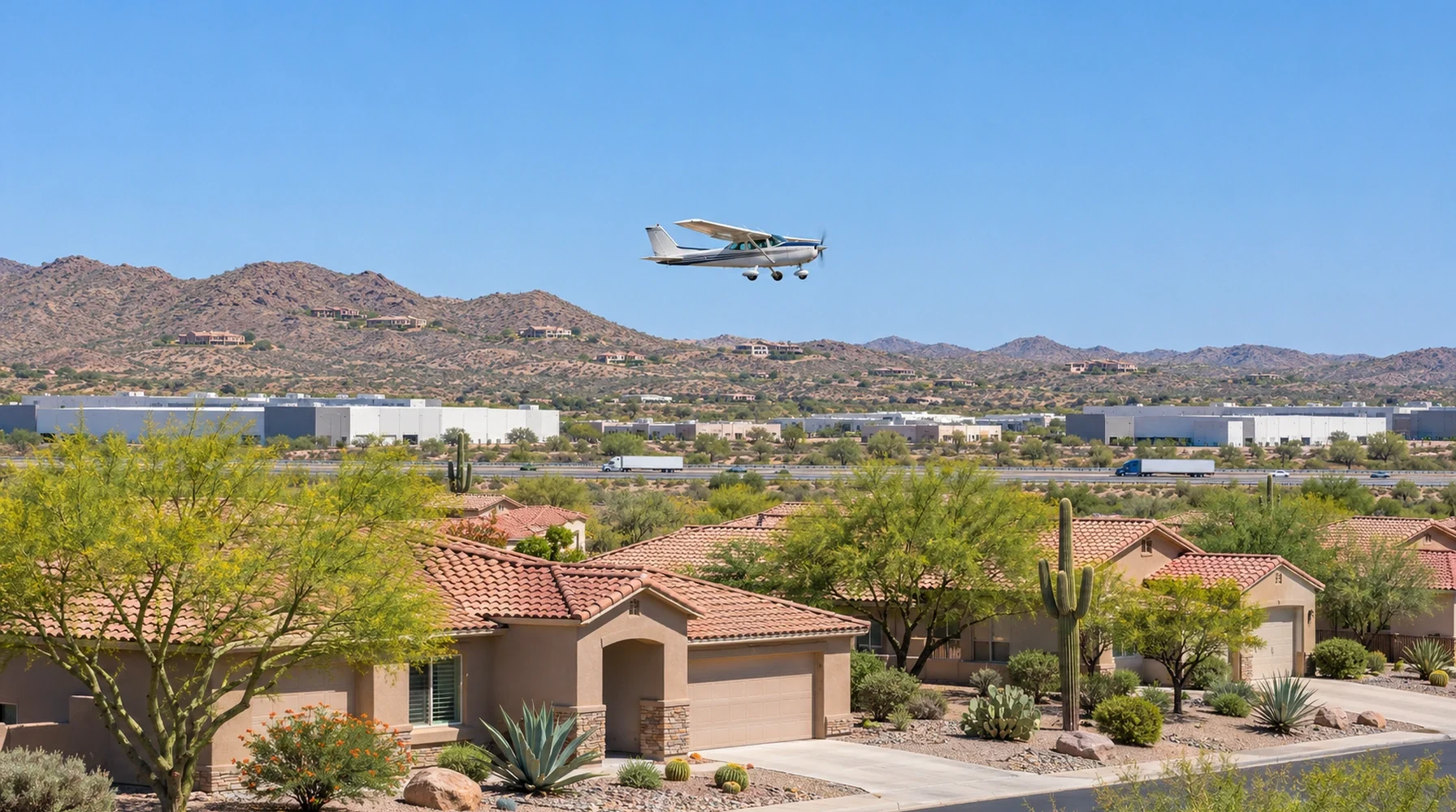
Busier, yes: the Deer Valley corridor is absorbing TSMC-supplier industrial space, truck traffic and commuters at a pace the quieter areas aren’t. The noise picture needs more precision, because the dominant sound near Deer Valley Airpark is the airport itself, already the busiest general aviation airport in North America, so it’s a present-tense fact to evaluate, not a TSMC projection. Desert Hills and Tatum Ranch are quieter by character, though neither is frozen in place, and the right diligence for all three happens at the address level: flight paths, surrounding zoning and arterial exposure for the specific home.
This question shows you’re thinking about the right risk: not whether North Phoenix will grow (it will), but what that growth sounds and feels like from a specific driveway. The areas you’ve named sit at three very different distances from the action. The Deer Valley Airpark area sits inside the employment engine, near I-17 and Loop 101 with the airport at its center. Desert Hills offers unincorporated, acre-lot desert living north of Carefree Highway. Tatum Ranch sits to the east, up the Tatum Boulevard corridor toward Cave Creek, an established suburban master plan a full mountain ridge removed from the industrial story. Each is a legitimate choice for a different buyer. The mistake would be treating “near jobs” and “quiet” as a simple trade where one address wins. Here’s what’s actually loud today, what’s actually changing, and how to evaluate any specific home before you commit.
The Noise That’s Already There: Understanding Deer Valley Airpark
The noise near Deer Valley Airpark in north Phoenix comes mainly from the airport, and it is here today, before any TSMC effect you’re worried about. Phoenix Deer Valley Airport reports nearly 500,000 takeoffs and landings in 2025, which it says makes it the busiest general aviation airport in North America. General aviation means private, training and business flights rather than airline service, and the airport is home to nearly 1,100 aircraft and several high-activity flight schools, so its traffic is dominated by small training aircraft flying repetitive patterns, heaviest on clear mornings.
If you tour a resale near the Airpark, the aviation noise you hear is not a preview of the future; it’s the established baseline, and it’s been part of the neighborhood’s pricing for decades. That cuts two ways. Homes there are typically priced with the airport already reflected, so you’re not paying a premium for quiet you won’t get, but you should also assume flight activity stays strong, because a thriving regional economy keeps flight schools and business aviation busy.
The practical takeaway: evaluate aviation noise in person, not by rumor. Visit the specific street on a clear weekend morning when pattern traffic peaks, note the home’s position relative to the parallel runways’ east-west alignment, and ask neighbors directly. A home two miles off the departure corridors and a home under the pattern can be minutes apart and live completely differently.
What TSMC Actually Adds to the Corridor
TSMC adds activity to the Deer Valley corridor in north Phoenix more than it adds noise, because the chip plants themselves are not at the Airpark. The fabs (chip factories) sit farther north near I-17 and Loop 303, and TSMC’s Arizona commitment stands at $165 billion.
Meanwhile, the supplier ecosystem is filling the Deer Valley employment corridor fast. Industrial projects built specifically for chip-supply tenants near the airport have leased up quickly, millions of square feet of industrial space have been rising across northwest Phoenix, and the City of Phoenix’s own Deer Valley Village plan designates the area for exactly this: large employment centers alongside its neighborhoods.
What that means for daily life near the Airpark is less about decibels and more about tempo: more trucks on the arterials, more commuters at the freeway interchanges, more midday activity, and more services staying open later because workers are present around the clock. For a homeowner, that’s a mixed ledger. The congestion is real and will grow with the job base. So will the thing congestion signals: a deepening employment anchor minutes from your front door, which historically supports housing demand and how easily homes resell. Busy corridors are rarely the cheapest places to live precisely because the busyness is purchased convenience. The useful framing isn’t “will it get busier” (it will) but “is that a cost I’m paid for, or just a cost?”
How Desert Hills and Tatum Ranch Actually Compare
Desert Hills and Tatum Ranch both deliver a quieter character than the Deer Valley Airpark area, but through different mechanisms, and neither sits outside North Phoenix’s growth story entirely. Desert Hills is unincorporated Maricopa County: acre-plus lots, custom homes, horse privileges, no HOAs across much of the area, shared wells and septic systems, dark skies and genuine elbow room. Its quiet is structural; low density does the work.
But notice where Desert Hills sits: just east of the I-17 corridor that carries the region’s growth northward, with freeway improvements and large-scale planning activity working their way up that spine. Desert Hills’ interior will likely stay rural in character for a long time, but its edges and its commute arteries will feel the region growing, and acreage living carries its own diligence load: well agreements, septic condition, road maintenance and flood-zone questions replace the HOA review. Our guide to buying acreage in Desert Hills walks through each of those checks.
Tatum Ranch’s quiet comes from the opposite design: an established, fully built-out suburban master plan with golf, schools and HOA-kept streets, positioned a mountain ridge east of the industrial corridor. Its exposure isn’t industrial at all; it’s arterial. The Tatum Boulevard corridor that connects it southward is one of North Phoenix’s harder-working roads and continues to absorb residential and commercial growth at its lower end.
And both areas pay a commute tax to the TSMC corridor that the Airpark-area buyer doesn’t: what’s minutes from Deer Valley is a meaningful daily drive from Desert Hills, and a longer one from Tatum Ranch. My broader framework for weighing commute, amenities, and lifestyle between submarkets applies directly to this three-way comparison.
Match the Area to the Buyer, Not the Headline
Each of these three North Phoenix areas, the Deer Valley Airpark area, Desert Hills and Tatum Ranch, is the right answer for a specific household and the wrong one for the other two. This is usually where I slow buyers down. The Airpark-area resale fits the buyer who works in the corridor, values a short commute and established (often more attainable) housing, and has personally stood in the backyard during morning pattern traffic and shrugged. Desert Hills fits the buyer who wants land, animals, workshops and quiet as a way of life, accepts well-and-septic stewardship, and treats the longer drive as the price of space. Tatum Ranch fits the buyer who wants conventional suburban polish (golf, HOA standards, established schools) and whose work or life leans east, making the industrial corridor someone else’s geography.
What I watch for here is buyers optimizing for a headline (“TSMC is coming!”) instead of their own week: drive your actual commute at your actual hour from each candidate area before you write anything. If you’re relocating from out of state and can’t easily do that in person, my guides to buying from out of state by virtual tour and what your budget actually buys across the Phoenix area cover how to do this evaluation remotely without guessing.
– Christopher, Goodyear, AZ
The Address-Level Checklist Before You Commit
Whichever area wins, the final diligence for a home near Deer Valley Airpark, in Desert Hills or in Tatum Ranch happens at the parcel, not the ZIP code, and five checks cover most of it:
- Near the Airpark: Pull the airport’s published noise and flight-track information, position the home against the east-west runway alignment, visit on a clear weekend morning and a weekday rush hour, and check the zoning on every nearby vacant or industrial parcel so you know what can be built there.
- In Desert Hills: Verify the well share agreement and production history, the septic inspection, road maintenance responsibility and floodplain status, and look at county and state plans for the nearby I-17 corridor so the area’s growth edges don’t surprise you.
- In Tatum Ranch: Read the HOA documents, and drive Tatum Boulevard at peak hours to price the arterial reality into your commute.
- Everywhere: Ask what’s entitled (already approved to be built), not just what’s built, because zoning maps answer the “will it get busier next to me” question far more reliably than any forecast.
- Inside your contract: Schedule these checks inside the 10-day inspection period in Arizona’s standard purchase contract, because that is your window to negotiate or cancel if something turns up.
Then protect the purchase itself with a well-structured contract; my guide to writing an offer that protects you after inspections applies to all three areas. At this stage, I help clients narrow their focus to specific streets in each candidate area and let the visits, not the headlines, make the call.
Frequently Asked Questions About Deer Valley Airpark, Desert Hills and Tatum Ranch
How busy is Deer Valley Airport?
Phoenix Deer Valley Airport reports nearly 500,000 takeoffs and landings in 2025, which it says makes it the busiest general aviation airport in North America. It is home to nearly 1,100 aircraft, and small training aircraft dominate its traffic.
Will TSMC growth increase noise near Deer Valley Airpark?
The bigger TSMC effect near the Airpark is activity, not decibels: supplier industrial space, truck traffic and commuters are growing in the corridor. Aviation noise is already substantial from the airport’s existing operations, so evaluate it at the specific address.
When is aircraft noise heaviest near Deer Valley Airport?
Training traffic flying repetitive patterns is heaviest on clear mornings. Visit the specific street on a clear weekend morning to hear the real baseline before you make an offer.
Where are the TSMC fabs in relation to Deer Valley Airport?
The TSMC fabs sit farther north near I-17 and Loop 303, not at the Airpark. The Deer Valley corridor is filling with supplier industrial space and the trucks and commuters that come with it.
Is Desert Hills in the path of North Phoenix development?
Desert Hills’ interior is low-density, unincorporated acreage living and is likely to keep that character, but it sits east of the I-17 corridor carrying the region’s growth north. Expect its commute arteries and edges to feel that growth.
Does Desert Hills have an HOA?
Much of Desert Hills has no HOA. In place of an HOA review, you check the well agreement, septic condition, road maintenance responsibility and floodplain status for the specific parcel.
Is Tatum Ranch affected by the TSMC industrial corridor?
Not directly. Tatum Ranch sits well east of the I-17 industrial corridor toward Cave Creek. Its growth exposure is arterial instead: the Tatum Boulevard corridor connecting it south continues to absorb development and heavy traffic.
How do I check noise and future development before buying a specific home?
Visit at peak times, pull the airport’s published noise and flight-track information, and check city or county zoning maps for nearby vacant parcels to see what’s entitled, not just what’s built today.
The Bottom Line
Yes, homes near Deer Valley Airpark will keep getting busier, because that’s what a successful employment corridor does, and the airport at its center is already the busiest of its kind in North America. But “busier than Desert Hills or Tatum Ranch” was true before TSMC and will stay true after; the real question is which trade you want. The Airpark area sells proximity and pays in tempo. Desert Hills sells space and quiet and charges a commute plus well-and-septic stewardship. Tatum Ranch sells suburban polish a ridge away from the industry and charges its own arterial congestion and distance.
None of these is a wrong answer, but only one of them matches how your household actually lives, and a few well-timed visits will tell you which. Matching the area to your real week instead of the headline is how you make this move with clarity and confidence, and it is the street-by-street planning I bring to every buyer comparing North Phoenix areas.
If you want to talk through how airport noise, TSMC growth and commute trade-offs affect the specific homes you’re considering, let’s chat. You can reach me, Kasandra Chavez with the Chavez Dream Home Team, at 928-910-7401, or grab a time on my calendar.