



The Metropolitan Townhomes or a North Phoenix Resale Now?
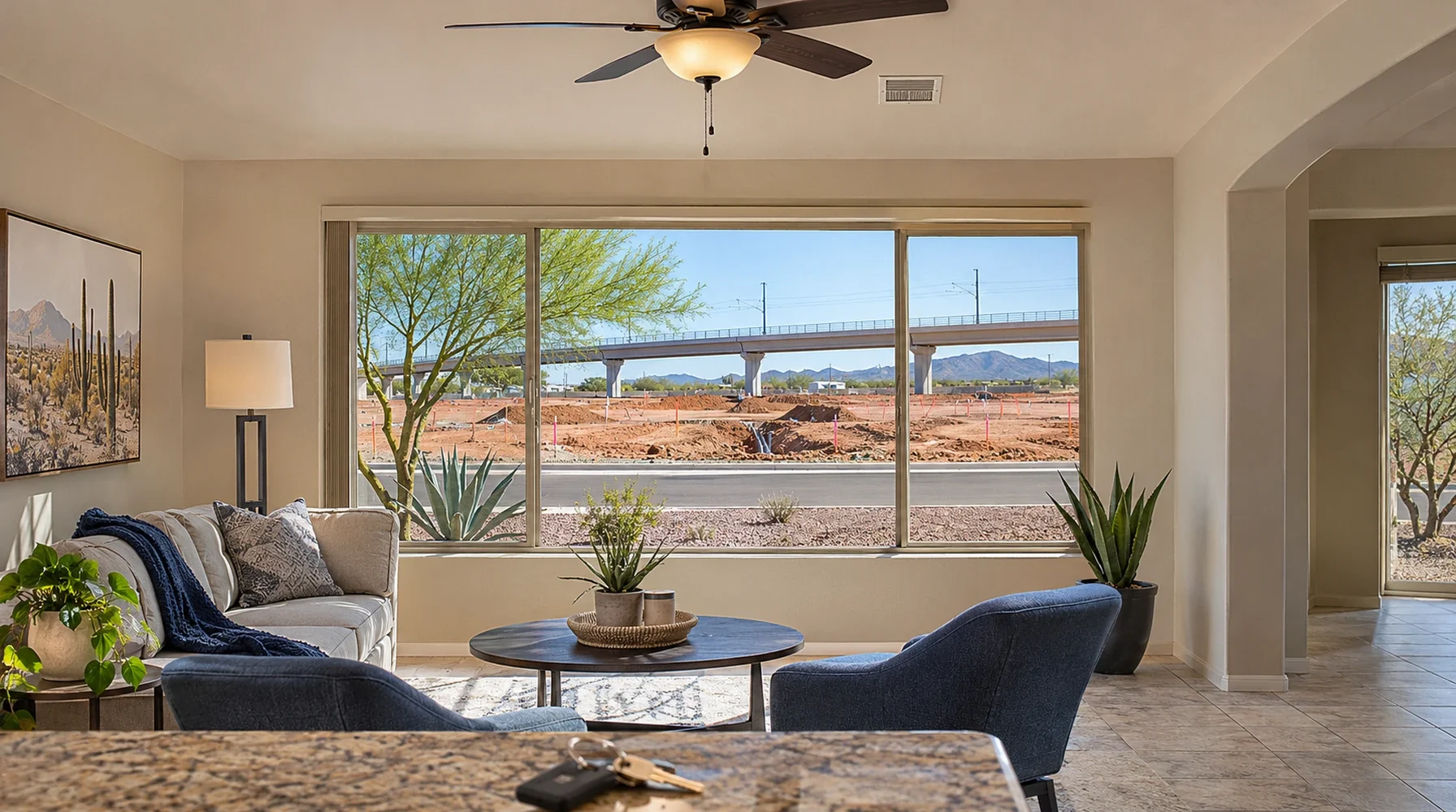
Should I wait for The Metropolitan’s for-sale townhomes or buy an established North Phoenix resale now if commute, HOA costs, and delivery risk are my priorities?
If those three things are your priorities, buy the established North Phoenix resale. The Metropolitan’s for-sale townhomes had no confirmed residential builder in the latest public reporting, no vertical housing construction underway, and a housing start that has moved to early 2027, so delivery risk is the one variable you cannot control. A resale gives you a known commute, a known HOA, and a real closing date.
I get this question in two very different forms. Some buyers have seen the renderings of The Metropolitan rising from the old Metrocenter site and want to know whether it is worth holding out for something new, walkable, and next to light rail. Others already have a resale under consideration in Deer Valley or Moon Valley and want permission to stop second-guessing themselves. Both are reasonable places to be standing.
What makes this harder than it looks is that the two options are not competing on the same timeline. One is a house you could own within about 30 days of an accepted offer; the other is a plan still assembling its team. Compare them on features alone and you are comparing a finished thing to an idea. This is usually where I slow buyers down, because the real comparison is not about which product is nicer. It is about what each path costs you in the years before move-in.
Where The Metropolitan Actually Sits in North Phoenix
The Metropolitan occupies the former Metrocenter Mall site along Interstate 17 between Peoria and Dunlap avenues in Phoenix, roughly 64 acres being rebuilt as a mixed-use urban village. This matters more than it first appears, because “North Phoenix” covers a lot of ground, and The Metropolitan is not in the part many people mean.
When people talk about North Phoenix in the context of new construction, they often mean the Norterra, Sonoran Foothills, and Union Park corridor further north along I-17, near the semiconductor campus. The Metropolitan sits well south of that. If your commute anchor is the North Gateway employment area, The Metropolitan is a longer drive than the corridor communities. If your anchor is downtown Phoenix, midtown, or the East Valley, the calculation flips entirely.
That flip is largely about transit. The Metropolitan connects directly to the Thelda Williams Transit Center, the northern end of Valley Metro’s light rail B Line. Valley Metro’s Northwest Extension Phase II opened in January 2024, adding three stations, the system’s first elevated station, and a rail-only bridge over I-17. Very few places in the Phoenix metro give a homeowner rail access at the front door. That is a real argument in The Metropolitan’s favor, separate from timing, and it means a Metropolitan owner could reach downtown without adding a car trip to the daily budget.
What Happened to The Metropolitan’s Construction Timeline
The Metropolitan’s residential timeline has moved, and the builder has changed. Oakwood Homes was named exclusive residential builder in fall 2025, with construction announced for April 2026. In mid-2026 Oakwood withdrew; KTAR reported the withdrawal in June 2026, quoting Oakwood’s Arizona division president. Master developer Concord Wilshire has been selecting a replacement national homebuilder, and housing construction is now set to begin in early 2027.
Two other facts shape what is left to buy. The entry-priced phase, Terra Court, 144 townhomes nearest the light rail, was reported fully pre-sold before ground was broken, as was the project’s rental phase, and the remaining for-sale phases step up from there. According to AZ Big Media’s October 2025 look at the plan, Terra Court started in the low $400,000s and was 100% pre-sold, and the next phase up, Luna Villas, started in the low $500,000s and was about half pre-sold. “Pre-sold” here means buyers reserved homes before construction began. So a buyer arriving today is not choosing between an affordable new townhome and a resale. The most affordable new product at The Metropolitan is already spoken for.
None of this means the project is in trouble. Large redevelopments change partners, and the City of Phoenix has been an active participant in the Metrocenter redevelopment since demolition began. It does mean anyone waiting is waiting on a schedule that has already moved once.
When a buyer tells me they are willing to wait for a project, I want them looking at the specific things that push move-in dates, not at renderings:
- Builder continuity: Changing residential builders mid-stream restarts parts of the design, pricing, and contracting process before anyone pours a foundation.
- Horizontal before vertical: Streets, water, and sewer go in before homes, and on a site the size of The Metropolitan that phase runs on its own multi-year clock.
- Phase order: Early and late phases are different purchases, because late phases can trail the first by years and carry different pricing.
- Pre-sold inventory: When a phase reports as fully reserved before construction, the product at that price point is gone, and the next release is the one you are actually buying into.
- Amenity sequencing: The retail core and shared amenities that make an urban village feel finished are delivered last, so early residents live in a construction zone.
HOA Costs at an Attached Townhome vs. a Detached North Phoenix Resale
Attached townhome HOA dues in a mixed-use community like The Metropolitan generally sit higher than dues on a detached North Phoenix resale, but they are not simply more expensive. They cover different things, and what sits inside them matters more than the number.
An attached-product association typically maintains the roof, exterior paint, and common landscaping, and funds shared amenities. Those are costs a detached homeowner pays too, just unpredictably: a roof does not send a monthly invoice, it sends one large one. A mixed-use village with structured parking and a retail core also carries more common infrastructure, and can involve both a master association (the community-wide HOA) and a neighborhood-level one. In an established North Phoenix resale, dues are lower and narrower, and you carry the exterior yourself.
| What you’re weighing | The Metropolitan townhome | Established North Phoenix resale |
|---|---|---|
| Available to buy today | No: entry phase pre-sold, no builder selling the later phases yet | Yes, with active inventory to choose from |
| Delivery certainty | Housing start moved to early 2027; builder being replaced | Contractual close, roughly 30 days under the AAR contract |
| HOA scope | Broader: exterior, roof, shared amenity and common areas | Narrower: you carry roof and exterior yourself |
| Transit access | Light rail at the door via Thelda Williams Transit Center | Car-dependent in most North Phoenix neighborhoods |
| Condition risk | New construction with builder warranty | Known through a 10-day inspection period |
The AAR contract in that table is the standard Arizona Association of REALTORS® purchase contract. It sets the 10-day inspection period, the window in which you inspect the home and review the HOA documents, and a title company handles the closing. In practice, that means every one of the three priorities you started with can be checked on a resale before you are committed.
– nicholaskingbear, Phoenix, AZ
What I Watch For When a Buyer Wants to Wait
What I watch for here is whether a buyer is giving up leverage they hold today in exchange for a future they cannot schedule. Greater Phoenix has been running buyer-favorable, with inventory elevated and price growth flat to modest across much of the metro. That posture is what gives a North Phoenix resale buyer room to negotiate, ask for concessions, and take the full inspection period without pressure.
That leverage is a present asset, and it is spendable now. A buyer waiting two or three years for The Metropolitan is also betting conditions will be at least as favorable when the phase they want releases, and new construction released into a tighter market does not come with concessions. Rent paid during that wait builds no equity, while a resale bought in a soft market starts building it immediately. For a fuller version of that math, my guide to new build versus resale in the West Valley walks through the same trade-offs, and my comparison of new infill homes versus older resale covers the deferred-maintenance side of buying something already built.
Who Should Actually Wait for The Metropolitan
Waiting for The Metropolitan makes sense for a narrow group: a buyer who specifically wants a car-optional, transit-connected lifestyle, is not on a housing deadline, and can absorb a delivery date moving again. For that person, The Metropolitan is close to unique in this market, and no North Phoenix resale substitutes for it.
Everyone else is usually better served by an existing home. If walkability rather than light rail is what drew you, North Phoenix communities deliver that today: my Union Park at Norterra community guide covers the closest existing equivalent, and I’ve also looked at whether walkability adds resale value across the region. If what drew you was the low-maintenance attached product, my comparison of a lock-and-leave Union Park townhome covers that ownership style in a community you can buy into now.
Frequently Asked Questions About The Metropolitan and North Phoenix Resales
Is The Metropolitan the same site as the old Metrocenter Mall?
Yes. The Metropolitan is the redevelopment of the former Metrocenter Mall site along I-17 between Peoria and Dunlap avenues in Phoenix. Demolition of the mall was completed in 2025, and the site is being rebuilt as a mixed-use urban village.
Can I buy a townhome at The Metropolitan right now?
No. The entry-priced phase and the rental phase were reported fully reserved before construction, and no builder was selling the remaining for-sale phases in the latest reporting. Housing construction is set to begin in early 2027.
Why did The Metropolitan’s timeline change?
Oakwood Homes, named the exclusive residential builder in fall 2025, withdrew from the project in mid-2026. The master developer has been selecting a replacement homebuilder, and the housing start moved from April 2026 to early 2027.
Who is developing The Metropolitan?
Concord Wilshire is the master developer of The Metropolitan, with the City of Phoenix as an active partner in the Metrocenter redevelopment. A replacement homebuilder for the townhomes was still being selected in the latest reporting.
Does The Metropolitan have light rail access?
Yes. The site connects to the Thelda Williams Transit Center, the northern terminus of Valley Metro’s light rail B Line, which opened as part of the Northwest Extension Phase II in January 2024.
Is The Metropolitan near the semiconductor campus in north Phoenix?
No. The Metropolitan sits along I-17 between Peoria and Dunlap avenues, well south of the North Gateway employment area where the semiconductor campus and communities like Norterra and Sonoran Foothills are located.
How long does it take to close on a North Phoenix resale?
Roughly 30 days under the standard Arizona purchase contract, with a 10-day inspection period near the start. A title company handles the closing, so you have a real move-in date on the calendar.
Are HOA dues higher on an attached townhome than on a detached resale?
Usually, because a townhome association often covers the roof, exterior paint and shared areas. A detached resale has lower, narrower dues, and you pay for the roof and exterior yourself when they need work.
The Bottom Line
If commute, HOA costs, and delivery risk are driving this decision, the established North Phoenix resale wins on two outright and ties on the third. You get a commute you can test before closing, an HOA whose documents you can read during your inspection period, and a closing date on a calendar. The Metropolitan may well become one of the more interesting places to live in Phoenix, but it is not a home you can buy this year, and the entry-priced product is gone.
If transit access is what you want and your timeline is genuinely open, waiting is defensible. If you need a home, buy the home. Putting a finished home and a moving schedule side by side, on the things you can actually check, is how you make your move with clarity and confidence, and it is how I walk every buyer through a wait-or-buy decision.
If you want to talk through how waiting for The Metropolitan compares with buying a North Phoenix resale for your specific situation, let’s chat. You can reach me, Kasandra Chavez with the Chavez Dream Home Team, at 928-910-7401, or grab a time on my calendar.