


How the Peoria Innovation Core Will Impact Peoria AZ Home Values
Will the Peoria Innovation Core (PICC) employment growth meaningfully impact Peoria AZ home values over the next 5 to 10 years?
Yes, meaningfully, but unevenly across the city and over a longer arc than most buyers and sellers assume. The Peoria Innovation Core is a 7,000-acre planned employment corridor northwest of Loop 303 and Lake Pleasant Parkway, anchored by Amkor Technology’s expanding semiconductor packaging and test facility.
Amkor groundbreaking happened in October 2025, with the company tripling its committed investment from $2B to $7B and the employee count expanding from 2,000 to 3,000 at an average salary near $100,000. That kind of high-wage employment within commuting distance of Peoria neighborhoods is a real, durable driver of housing demand, and it will move home values, particularly in North Peoria.
What it won’t do is move every Peoria home value at the same rate or on the same schedule. The neighborhoods closest to the corridor benefit first and most. The neighborhoods on the south end of Peoria benefit later and less directly. Here’s what I see playing out and what it means for buyers and sellers thinking about the 5-to-10-year arc.
What the Peoria Innovation Core actually is
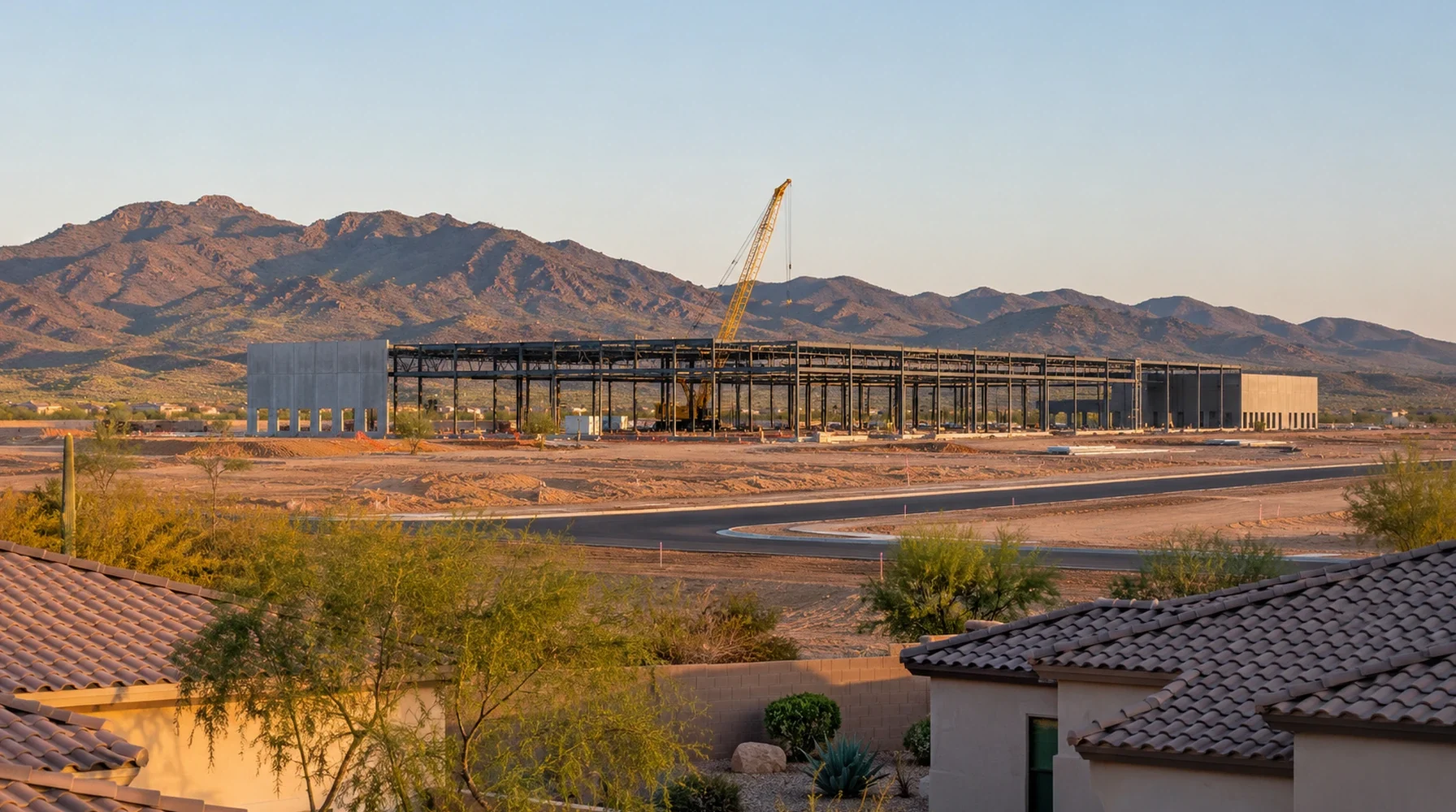
The PIC is roughly 10.5 square miles of planned employment, manufacturing, and supply-chain development northwest of Loop 303 and Lake Pleasant Parkway. The City of Peoria serves as master-planner and developer following a 2024 intergovernmental agreement with the Arizona State Land Department. Amkor moved its 56-acre Five North site allocation up to a 104-acre Core 2 site within the PIC in August 2025 to meet expanding business needs, and city infrastructure work, including Ashler Hills Road and required utilities, is underway. Construction on Amkor’s facility started in September 2025 with the ceremonial groundbreaking in October.
In March 2026, the City of Peoria announced a partnership with Opus Development to bring approximately 12.2 acres of multi-tenant speculative industrial product to Parcel C of the PIC, specifically positioned for Amkor and TSMC supply-chain companies. That’s the second land disposition of the 834 acres Peoria acquired through the State Land Auction. The pattern is clear: the city is building infrastructure first, attracting anchor employers, and then catalyzing supplier ecosystem buildout around them. That’s a deliberate, well-funded, multi-decade development model, not speculation.
Speculative industrial space means buildings put up before specific tenants have signed, so supplier companies can move in quickly. For a Peoria homeowner or buyer, that sequence matters because the jobs, and the housing demand that comes with them, arrive in stages rather than all at once.
Why high-wage employment moves housing demand
The link between major employer arrivals and nearby home appreciation is one of the better-documented patterns in residential real estate. High-wage employees need housing, prefer reasonable commutes, and tend to value newer construction, good schools, and master-planned amenities, all of which North Peoria delivers at scale. Add the suppliers, vendors, and supporting service workforce that follows an anchor like Amkor, and the demand profile compounds.
What I watch for here is the difference between announcement-driven price movement and demand-driven price movement. The announcement of TSMC’s investment in north Phoenix triggered a wave of speculative interest in West Valley communities, some of which has since cooled. The PIC will likely follow a similar pattern: an announcement and groundbreaking phase with some early speculative interest, then a construction lag where the actual employees haven’t arrived yet, then a sustained demand phase once the facility ramps to operational headcount. That third phase is where the durable appreciation lives.
Which Peoria neighborhoods benefit most
Geographic proximity matters more than buyers usually assume. The neighborhoods that benefit most from PIC employment growth are the ones a future Amkor employee or supplier-company employee will actually consider commuting from. That’s primarily North Peoria: Vistancia, Trilogy, the various Northpointe and Westwing neighborhoods, and the newer subdivisions along Lake Pleasant Parkway and the Loop 303 corridor. These are the homes within roughly fifteen to twenty minutes of the PIC site, and they’re the ones where the supply-demand math tightens first as employment builds.
Central Peoria neighborhoods will benefit too, but more diffusely. Some employees will choose more established neighborhoods with mature schools and existing amenities, accepting a longer commute. Some will be priced out of North Peoria and look south. The lift in central Peoria will be real but slower and less concentrated. South Peoria and the older established corridors farther from Loop 303 will see the smallest direct PIC impact, though they’ll continue to participate in broader Peoria appreciation driven by city-wide growth.
What this means for buyers in 2026
The buyer question is mostly about timing and tolerance. If you’re buying in North Peoria right now (Vistancia, Five North, Trilogy, the Lake Pleasant Parkway communities), you’re buying ahead of an anchor employer that’s under construction with a documented multi-year ramp. That positions you well for appreciation if the corridor plays out as planned. The risk is timeline drift. Large semiconductor facilities are complex; construction and operational ramp dates can move. A buyer with a five-year hold or longer is well-positioned for that risk; a buyer planning to sell in two or three years carries more.
For buyers comparing North Peoria positioning to other options, the underlying decision framework is the same as any community-vs-community comparison: schools, commute, amenity timing, hold horizon. Comparing Peoria and Phoenix on those decision factors walks through the same kind of structured trade-off framework one level out and translates cleanly to Peoria sub-market comparisons. If you are narrowing in on a specific home, our checklist on what to verify when buying near the Peoria Innovation Core covers the next step.
– ReyAna K, Peoria, AZ
What this means for sellers in 2026
For sellers, the PIC story is mostly a tailwind, but it doesn’t change the basic pricing math. The corridor’s long-term appreciation potential is real, but the buyer pool today is shopping today’s market, not 2030’s. Sellers who anchor their pricing to “what the corridor will be worth once the PIC ramps” are pricing against a future buyer who doesn’t exist yet. Sellers who price against current comps, market the corridor proximity clearly as a forward-looking value driver, and run a normal listing process tend to do well. The PIC strengthens the long-term Peoria story without rewriting the short-term pricing playbook.
Comps are recent sales of similar homes nearby, and they are what today’s buyers and appraisers measure your price against. Our guide to pricing and marketing a North Peoria home near the Innovation Core goes deeper on positioning a listing, and if you are weighing a move closer to the corridor, see whether to trade up your Peoria home to be near the Innovation Core.
What could go wrong with this forecast
Three things would meaningfully weaken the PIC’s impact on Peoria home values. First, a major delay or scaling-back of the Amkor facility itself: semiconductor capital projects sometimes get reshaped by demand forecasts, geopolitical shifts, or company-specific strategy changes. Second, a broader semiconductor downturn that slows TSMC, Amkor, and the supply-chain companies clustering around them. Third, a much slower-than-expected residential build-out in North Peoria that fails to deliver enough housing to absorb the demand the corridor generates, which would concentrate appreciation more narrowly and could push some employees to commute from outside Peoria.
None of these are likely individually. All are worth holding in mind. The City of Peoria publishes current information on PIC development through its official city news and economic development pages, which is the right place to track actual milestones rather than relying on speculative reporting.
Frequently Asked Questions About the Peoria Innovation Core and Home Values
What is the Peoria Innovation Core (PIC)?
A 7,000-acre planned employment and advanced manufacturing corridor in north Peoria, anchored by Amkor Technology and developed by the City of Peoria following a 2024 intergovernmental agreement with the Arizona State Land Department.
How many jobs will the PIC bring to Peoria?
Amkor alone is committed to 3,000 high-wage jobs at an average salary near $100,000. Supplier and supporting-industry jobs follow anchor employers and typically expand the headcount further.
Will the PIC raise property taxes in Peoria?
Property tax assessment is based on market value rather than on city economic development directly. Strong corridor performance can lift assessed values over time but doesn’t change tax rates.
Should I buy in North Peoria specifically because of the PIC?
If your hold horizon is five years or longer and you’re already considering North Peoria for lifestyle reasons, the PIC strengthens the case. Buying for the PIC alone with a short hold horizon is more speculative.
When does the Amkor facility actually open?
Construction started in September 2025 with the ceremonial groundbreaking in October 2025. Large semiconductor facilities typically take multiple years from groundbreaking to full operational ramp.
Where is the Peoria Innovation Core located?
The PIC covers roughly 10.5 square miles northwest of Loop 303 and Lake Pleasant Parkway. Amkor’s 104-acre Core 2 site sits within it, and the City of Peoria serves as master-planner and developer.
Which Peoria neighborhoods benefit most from the PIC?
North Peoria benefits first and most: Vistancia, Trilogy, the Northpointe and Westwing neighborhoods, and newer subdivisions along Lake Pleasant Parkway and Loop 303, roughly fifteen to twenty minutes from the PIC site.
Should I price my Peoria home higher because of the PIC?
Today’s buyers are shopping today’s market, not 2030’s. Price against current comps and market the corridor proximity as a forward-looking value driver. The PIC strengthens the long-term story without rewriting short-term pricing.
The bottom line
The Peoria Innovation Core is the most significant economic development project in Peoria’s history, and its impact on home values over a 5-to-10-year arc is likely to be substantial, particularly in North Peoria. Buyers and sellers should treat that as a directional tailwind rather than as a near-term pricing event. The corridor is a long story, and the homes that benefit most are the ones positioned within easy commute of the employment core. For most decisions made today, the PIC is a meaningful factor but not the deciding one. Lifestyle fit, hold horizon, and total cost still drive the right answer for any specific buyer or seller.
Separating the long corridor story from today’s pricing is how you make your move with clarity and confidence, and it is the lens I bring to every Peoria buyer and seller I work with.
If you want to talk through how the Peoria Innovation Core affects your specific home or search in Peoria, let’s explore your options. You can reach me, Kasandra Chavez with the Chavez Dream Home Team, at 928-910-7401, or grab a time on my calendar.